

Next week, the UK government will announce its latest budget.1
Every time this comes around, there’s intense debate about what financial holes we need to fill, whether we should raise taxes or cut spending, and which taxes we should change or leave untouched. Countless numbers are flying around, and I’ve struggled to find anywhere that puts them into context.
For my own sanity, I wanted to understand how large each tax lever is. Are we talking hundreds of millions, billions, tens of billions?
Running the numbers surprised me. The UK government spends £1.4 trillion a year. Raising the basic rate of income tax by one percentage point would raise £8 billion. The top rate, just £270 million. Estimates for an annual wealth tax (which is far more contested among economists) might raise £10 billion in an optimistic scenario. Not nothing, but less than 1% of current spending.
I’m not arguing that we should raise specific taxes, or even any taxes. That’s a political decision that’s more complex than just looking at how much revenue they’d raise. But I wanted a sense of perspective that might help to inform some of the broader discussions around taxes, spending, and deficits.
It’s also worth noting that the former prime minister, Keir Starmer, has tied Andy Burnham’s hands because he previously promised that the government wouldn’t touch many of the simple tax levers that I’ll show.2
Income tax
Let’s start with income tax. Like many countries, the UK has a progressive income tax system. The first £12,570 that someone earns is not taxed (it’s called a personal allowance).3
Tax rates then increase with income, often with sharp thresholds. Those on higher incomes don’t just pay more in absolute terms, but also as a share of their income.
The basic tax rate for income up to £50,000 is 20%. This rises to 40% for income between £50,000 and £125,000. And then the top rate for income over £125,000 is 45%.4
How much extra revenue would the government get if it raised each of those tax rates by one percentage point? You can see this as the green bars in the chart below.
Raising taxes for the top earners would raise an extra £270 million a year. Increasing the basic tax rate, which would hit most earners, would raise just over £8 billion. 30 times as much!
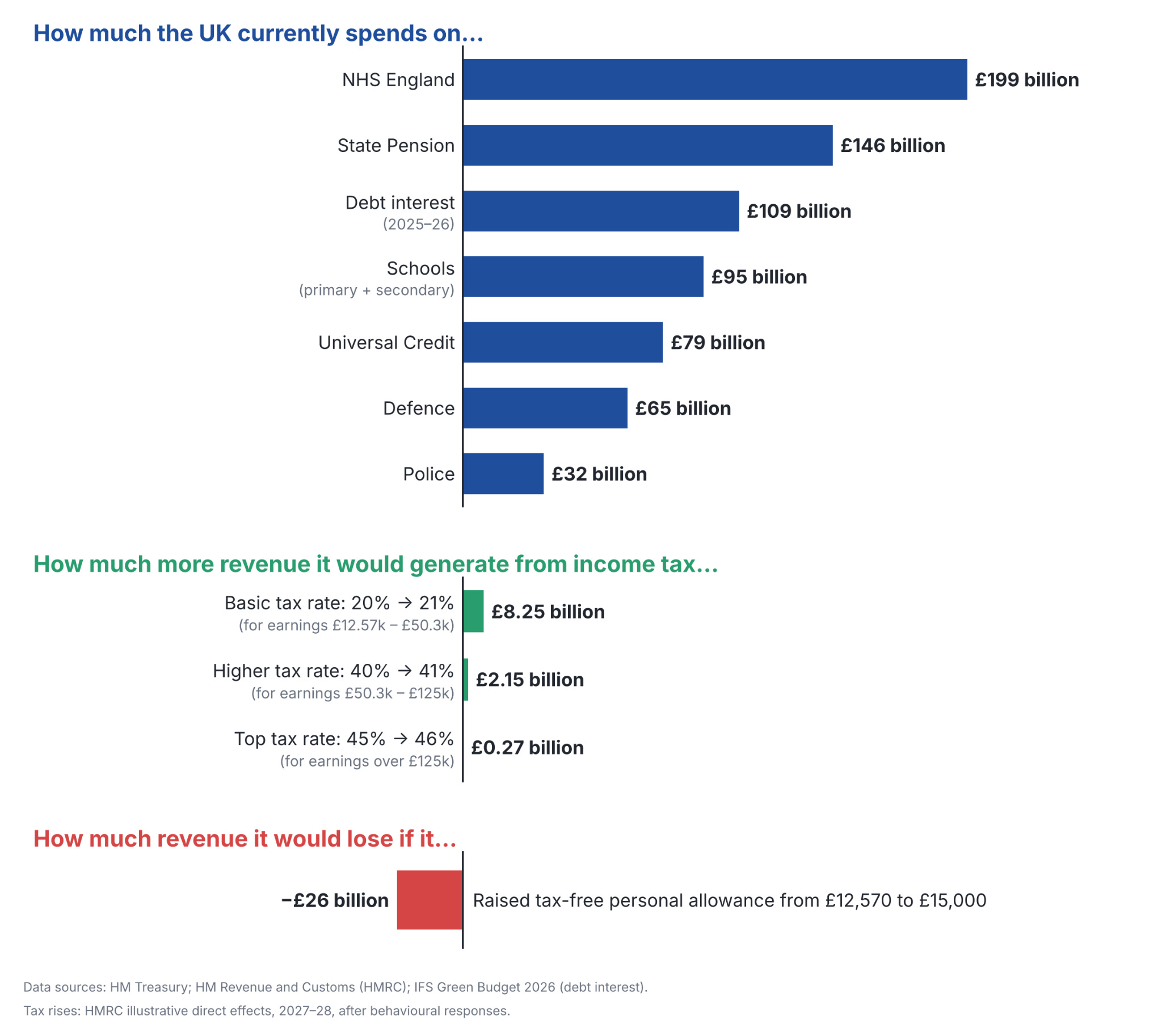
Raising tax rates at the top is simply less lucrative because there are far fewer people to tax.
That’s often the dilemma. Most people think those who are better off should pay more in taxes, not just in pounds, but as a share of their income, too. And they do. Still, increasing taxes at the top even more is far more popular than raising basic rates. It’s politically easier to do. The issue is that the numbers really bite. Even increasing rates from 45% to 50% won’t get the government much more than an extra billion.5
Raising basic rates from just 20% to 21% gets them over £8 billion in one go. But it also means increasing taxes for many who are already struggling financially.
In the chart, I’ve also given some examples of what the government currently spends money on.
Overall, the government spends around £1.4 trillion a year. NHS England alone costs around £200 billion. Pensions — which I covered in a recent post — are almost £150 billion.
What’s striking to me is how hard it is to raise any of these budgets by a substantial amount through tax increases. This is even more true at the top: an extra £1 billion from hiking up top rates to 50% is a drop in the ocean.
Finally, at the bottom, you’ll see a negative red bar. Reform, and the Liberal Democrats (yes, they appear to agree on something) have both said that they’d raise the personal tax-free allowance from £12,570 to £15,000.6
That would lose the government money. Possibly somewhere between £18 billion and £26 billion.7 That’s a significant dent that’s quite hard to fill. In particular, the argument that you can get it back by raising taxes at the top (effectively transferring income from the top to the bottom) would really not work, even just based on arithmetic.
VAT, Corporation tax and National Insurance
What about changes in other types of tax, like VAT, national insurance or corporation taxes?
I’ve added them to the chart below.
Raising VAT by one percentage point would raise the most, at around £9 billion. Increasing national insurance by the same amount would raise about a third less: around £6 billion. Corporation tax increases would raise about 40% of this.
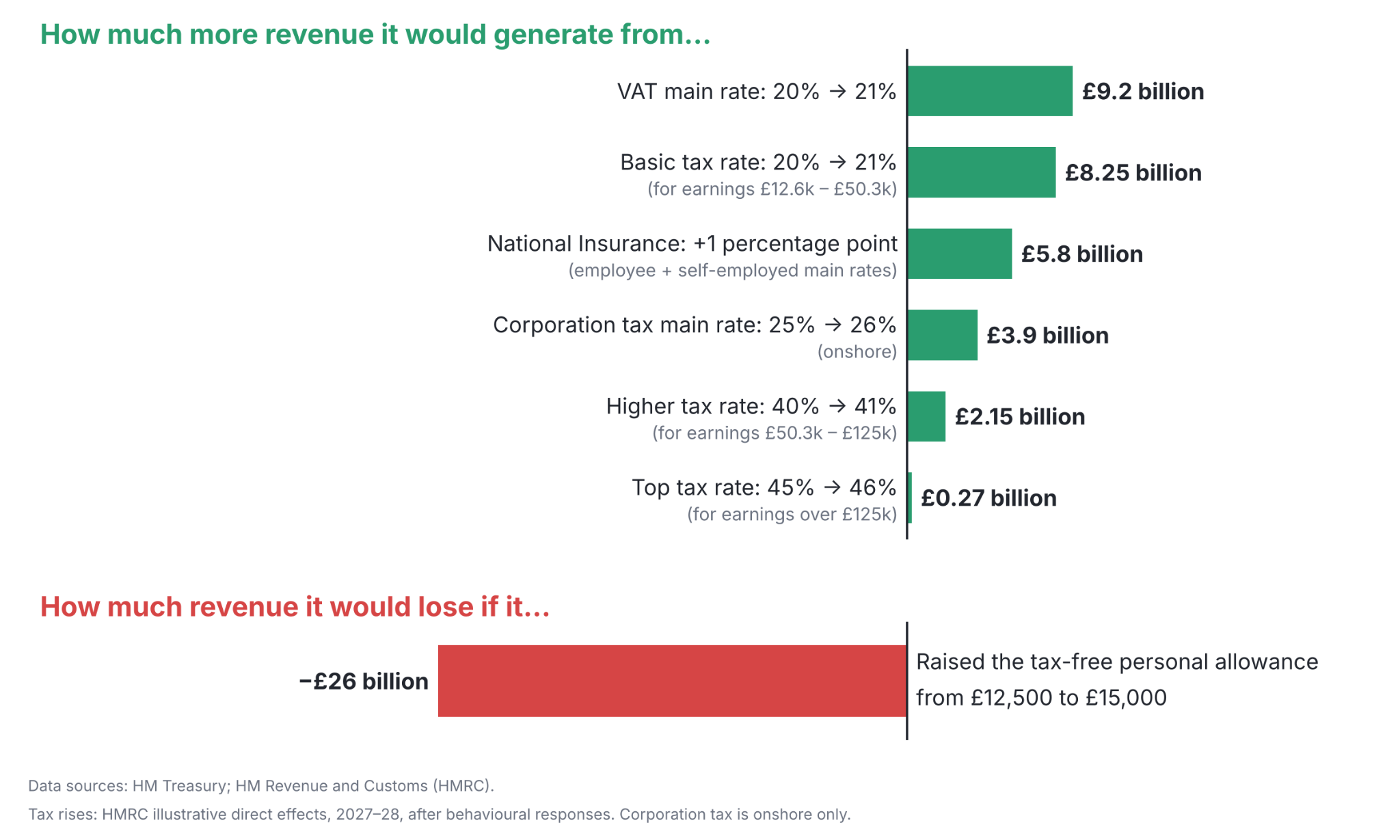
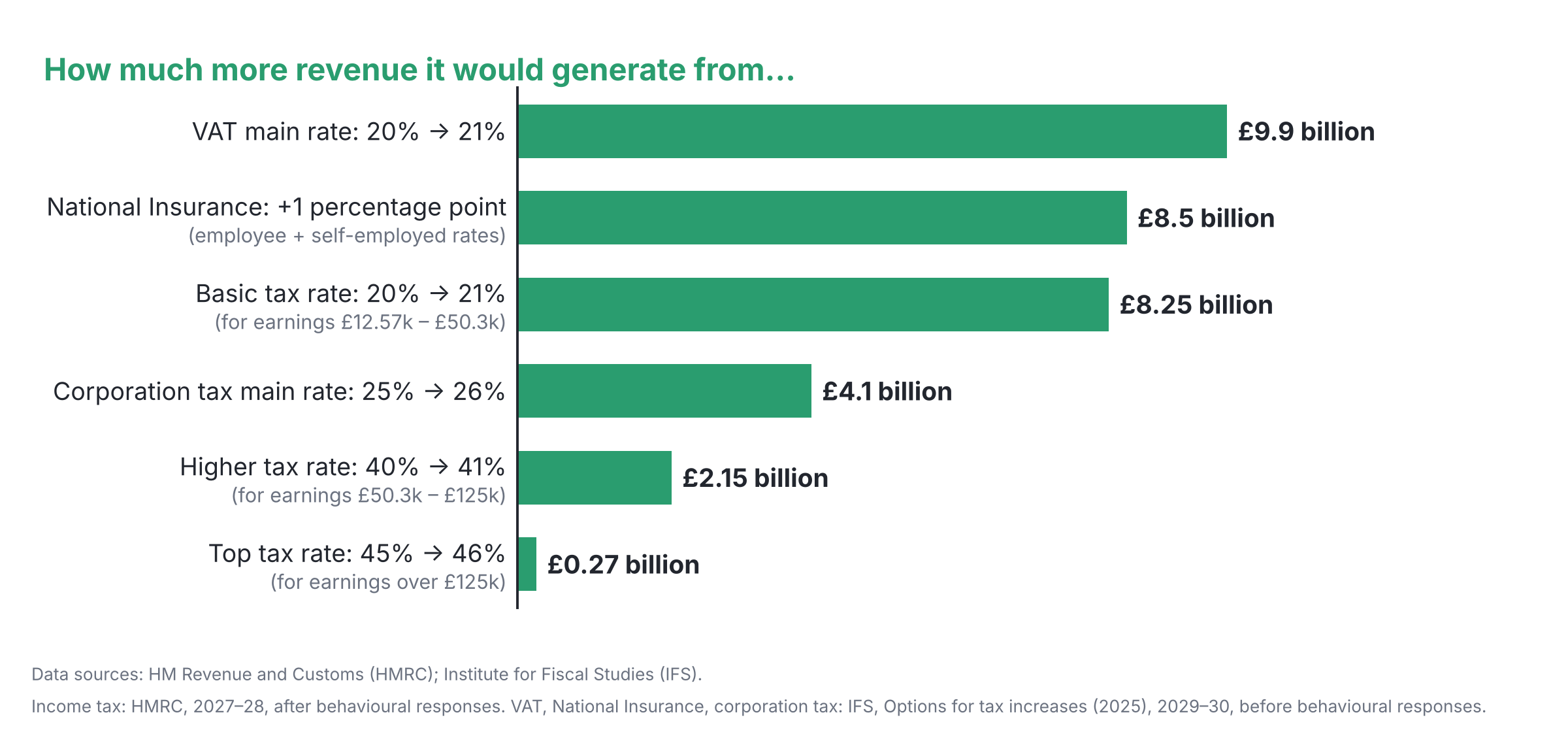
These tax revenue estimates come from the HMRC.8 The Institute for Fiscal Studies (IFS) also produces estimates of the effects of these changes.9 They can be very sensitive to methodology, what you assume about behavioural changes etc. I’ll include a chart with its figures in the footnote.10 It gets a similar figure for increases in VAT and corporation tax. But it thinks national insurance could raise more than the HMRC estimates: around £9 billion.
So sources disagree on the precise figure, but we’re still talking about revenue increases in the range of £4 to £10 billion.
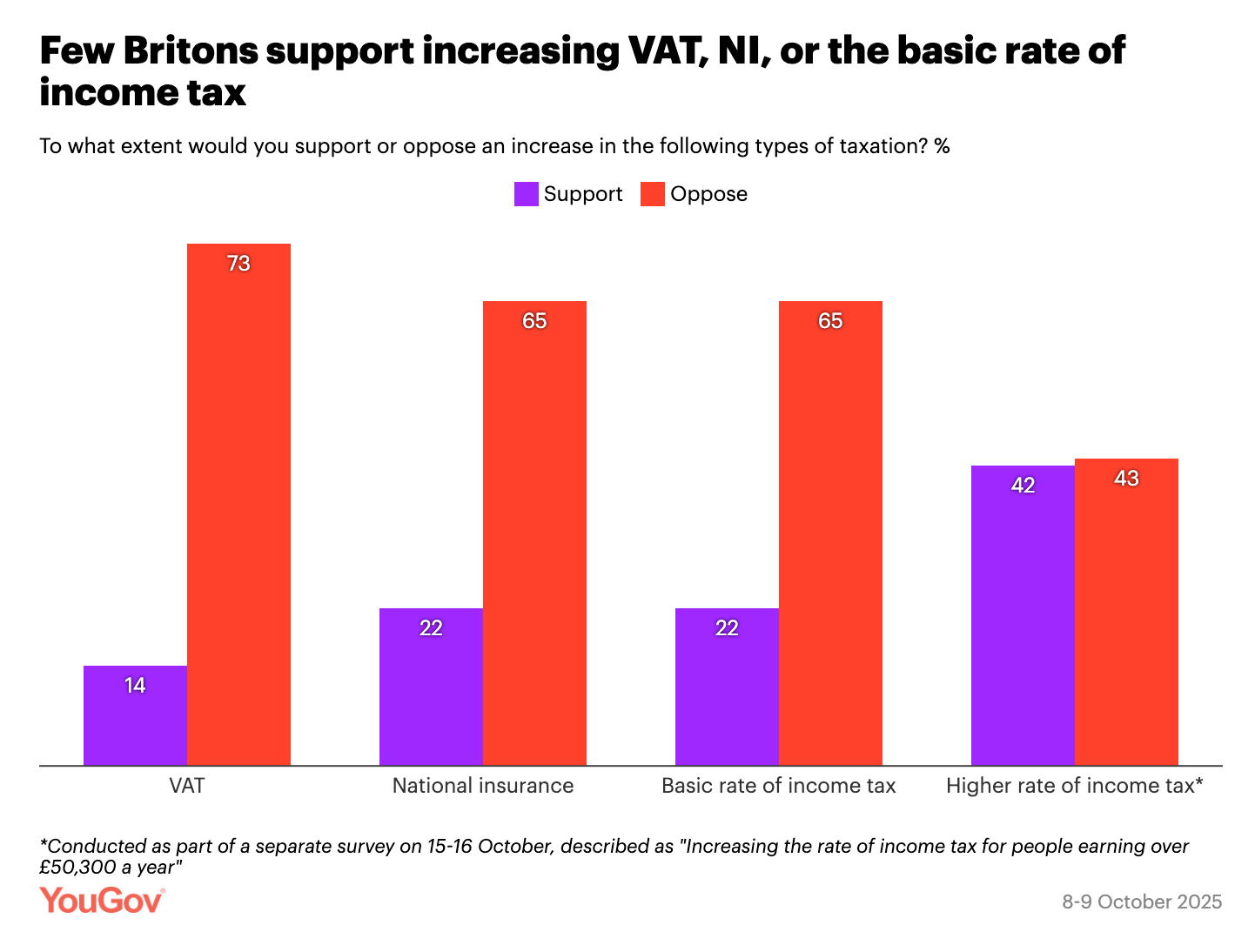
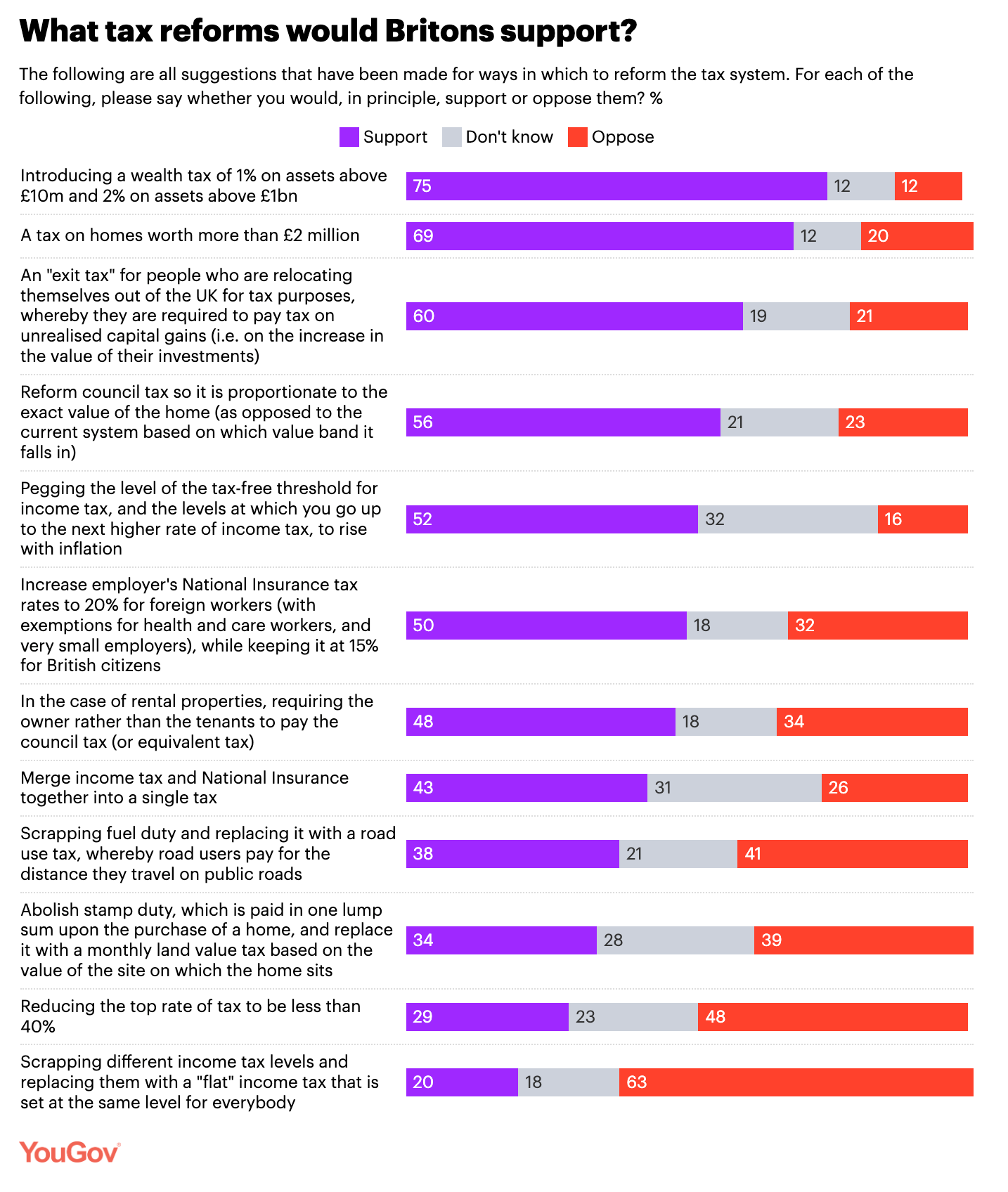
Again, all of these tax proposals are (unsurprisingly) unpopular. Here are the polling results from YouGov. The “most popular” in this set is increasing higher rates of income tax. That’s not even the top tax rates; I expect support for that would be even higher. Again, the bind here is that the most popular change would raise by far the least revenue.
What about an annual wealth tax?
Calls for an annual wealth tax have gathered a lot of momentum in British discussions. At least in the parts of social and mainstream media that I follow.
Gary Stevenson, one of its biggest advocates, has arguably done the most to popularise the idea through his YouTube channel, interview appearances, and a recent documentary on Channel 4.
I’m not going to go into all of the arguments for and against an annual wealth tax here. There is a strong moral argument for it: some of the wealthiest people manage to avoid paying any or little income tax. Not illegally, but purely because there’s no income to tax if they don’t pay themselves a salary or take out dividends.
But beyond the moral argument is the basic question of how much one might actually raise.
The economist, Gabriel Zucman, recently proposed a 2% minimum annual tax on wealth over £100 million. This is effectively a top-up: if someone in this bracket is already paying the equivalent of 2% of their wealth in tax through income tax, they won’t owe anything extra. If they’re not, their wealth gets taxed to top it up to this level.
He and his colleague, Ben Tippet, estimate that this would bring in around £10 billion a year in the UK. I’ve added this to our chart below.
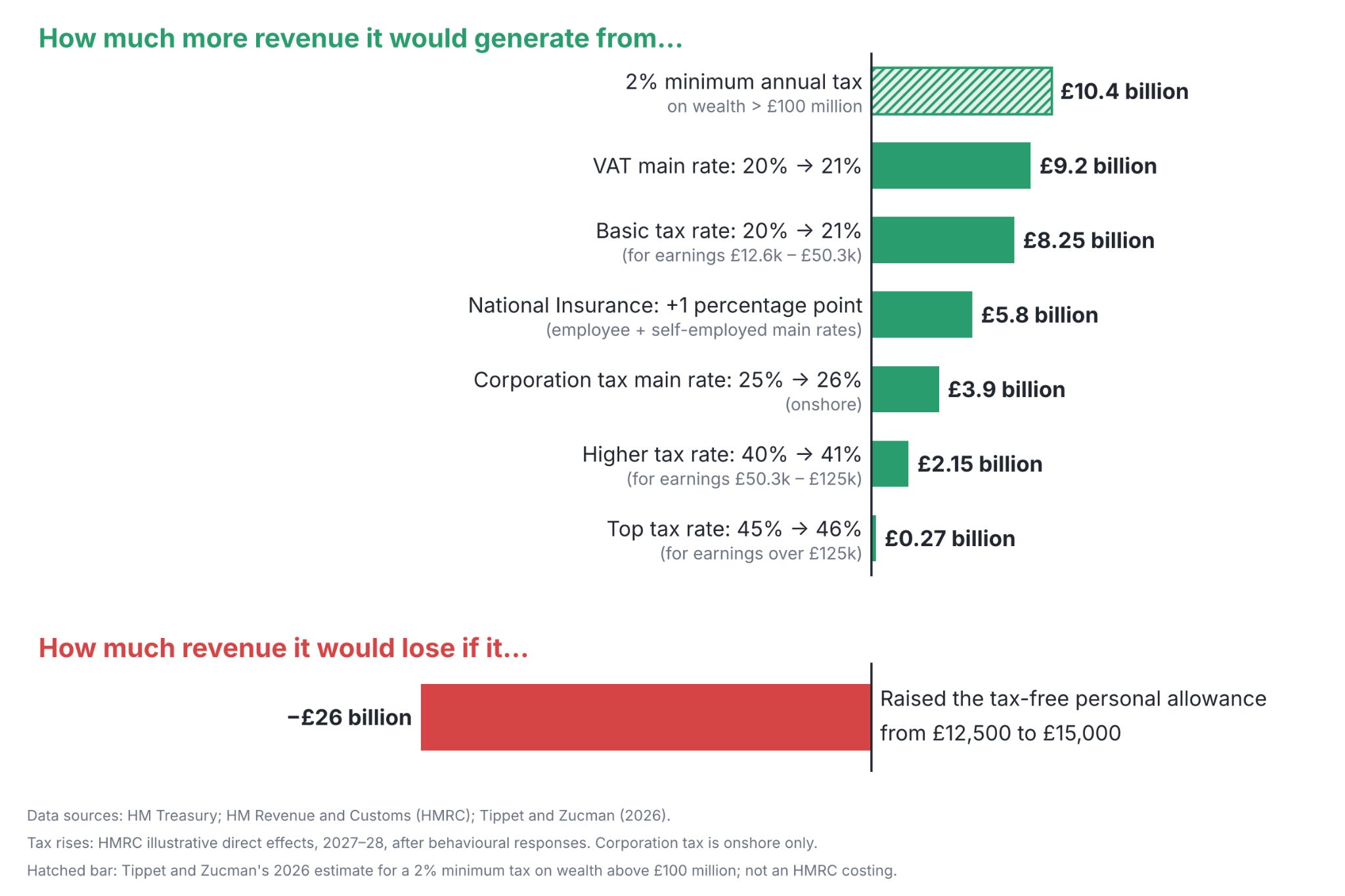
Now, there is a large asterisk on this number for several reasons. First, it wouldn’t affect this budget. Setting up the systems to do this would take several years.
There are also reasons why revenue might be a bit lower than the calculated £10 billion. People will often change their behaviour to get around these taxes. There are ways to ward against these loopholes — Zucman and Tippet propose that people are liable to pay for up to 10 years after they leave the country, which reduces the risk of people moving. But it’s probably hard to build a system that mitigates against all of them.
The history of wealth taxes in other countries suggests that you usually get less than you expect. It would take significant resources to do this: the government would need to assess who these wealthy households are, exactly how much wealth they have, and how this is changing over time. Again, not impossible, but harder than doing it for income, where we already have systems in place.
Regardless of whether we think an annual wealth tax is a good idea, £10 billion might be a slightly optimistic estimate.
Now, £10 billion isn’t nothing. But it would still only fill around a third of the gap left by raising the personal allowance to £15,000. Or increase government spending by 0.7%.11
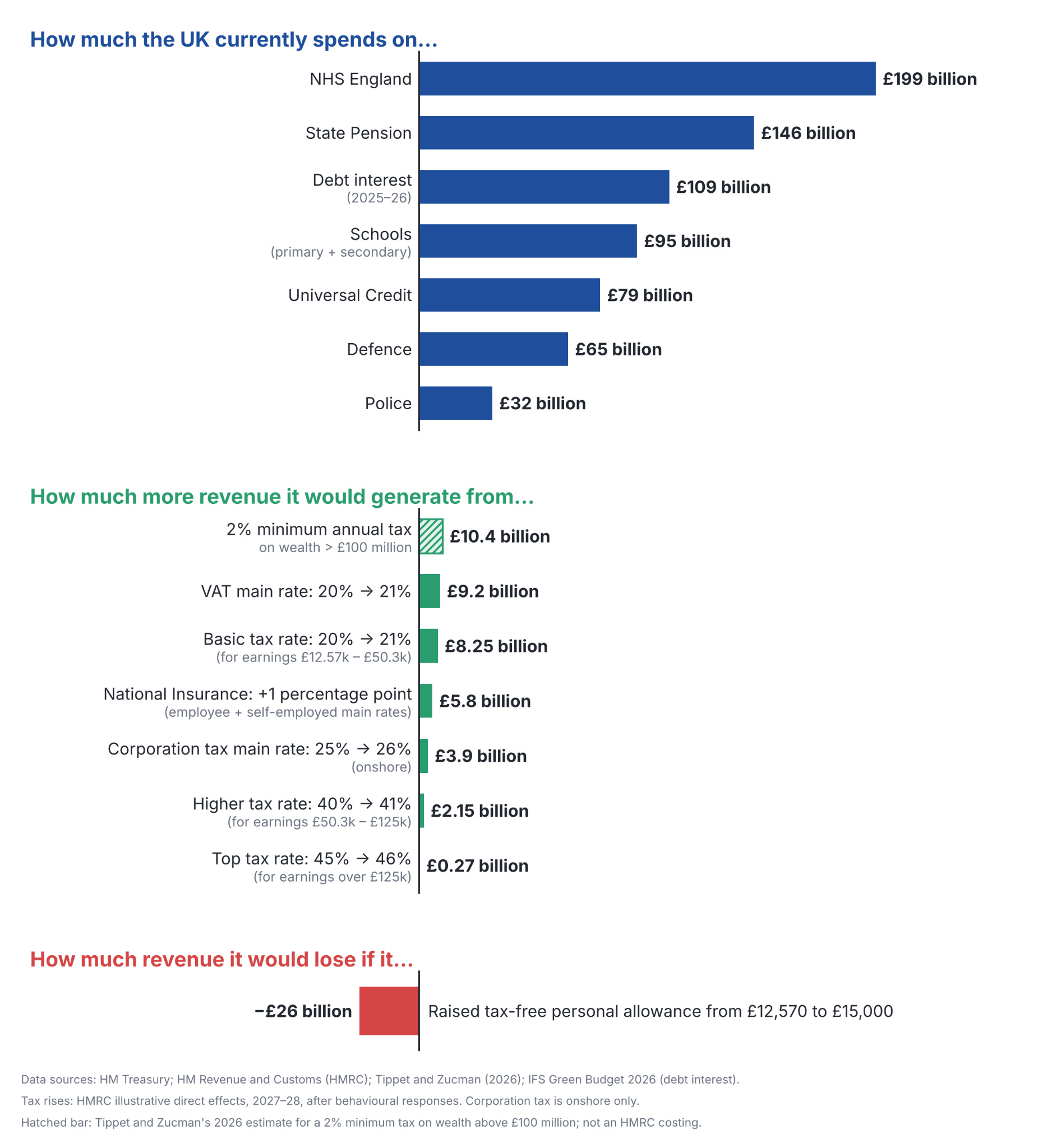
My sense from the public discussions is that people think it would go much further than this. Stack up the potential revenue, and it’s not that different from a marginal change in any of the other tax streams: a percentage point increase in income tax rates. Again, the moral argument is stronger. But the fiscal one is not that strong.
Wealth taxes are very popular, though. Around three-quarters of Brits support one. Below, you can see the levels of support for a wide range of tax reforms.12 I don’t have the space (or, in fact, all the figures) to look at the potential revenue from each of them.
But a general rule is that the reforms that are easiest to implement logistically, and that may raise the most revenue, tend to be the least popular. An uncomfortable situation for any government to be in.
The budget will be announced on the 28th of October.
From Labour’s 2024 election manifesto: “Labour will not increase taxes on working people, which is why we will not increase National Insurance, the basic, higher, or additional rates of Income Tax, or VAT.”
At least until someone reaches £100,000, at which point, the government claws it back in a complicated way.
Again, there is this weird blip between £100,000 and £125,000 where the rate goes absurdly high to claw back the £12,500 allowance. For simplicity, I'm going to ignore that here, but it's a quirk of the UK tax system that many people find absurd.
Also, in Scotland, the top rate is 48%, not 45%.
This is a rough estimate because these numbers don't necessarily scale linearly: a 5 percentage point increase is often not the same as a one percentage point change, multiplied by 5.
In this case, I still think "roughly a billion" is the right ballpark.
Here's the announcement from the Liberal Democrats: https://www.libdems.org.uk/news/article/cutting-income-tax-to-tackle-the-cost-of-living-crisis
Here it is from Reform: https://www.tax.org.uk/reform-uk-conference-2026-tax-policy
The exact figure is uncertain. Reform put it between £18 billion and £21 billion.
HMRC estimates a costing of just over £1 billion per £100 of allowance. Scaling this linearly gives around £26 billion. This may be a slight overestimate, as this may not scale linearly.
HMRC = His Majesty's Revenue and Customs.
That's the UK's agency responsible for collecting taxes and enforcing tax law.
The HMRC estimates are for 2027/28.
The IFS estimates are based on forecasts for 2029/30.
Here are the IFS estimates for VAT, NI and Corporation tax:
Government spending is £1.4 trillion a year.
£10 billion is equal to 0.7% of this.
The wealth tax scenario proposed in the poll was slightly different from the Zucman and Tippet one we looked at earlier. But I expect the support for either would be similar.
I have been wondering how much you could raise by closing loopholes and going after tax-dodging corporations. It’s profoundly unfair that an independent coffee shop struggling to make ends meet pays tax but Starbucks and Cafe Nero pay absolutely none. The “they’d just leave” argument doesn’t work here either because people will still drink coffee so if they leave they’ll just be replaced by other coffee shops who pay tax. I would also be interested to hear about capital gains tax.
Maybe I'm too left but everything below 5% wealth tax would not really be a redistribution of wealth. 2% would slow the accumulation of ridiculous wealth a bit but never halt or even reverse it.
That being said, I definitely did expect higher gains from wealth taxes too.
I'm not familiar with british inheritance taxes (if any), but I'd be interested what changes to that could achieve.