
The UK needs to build more reservoirs
We haven't built any in my lifetime, despite population growth and a changing climate.

The UK has had an extremely dry summer. Look at photos online, and you’ll see the traditionally green parks looking like hay.
Just how dry have things been?
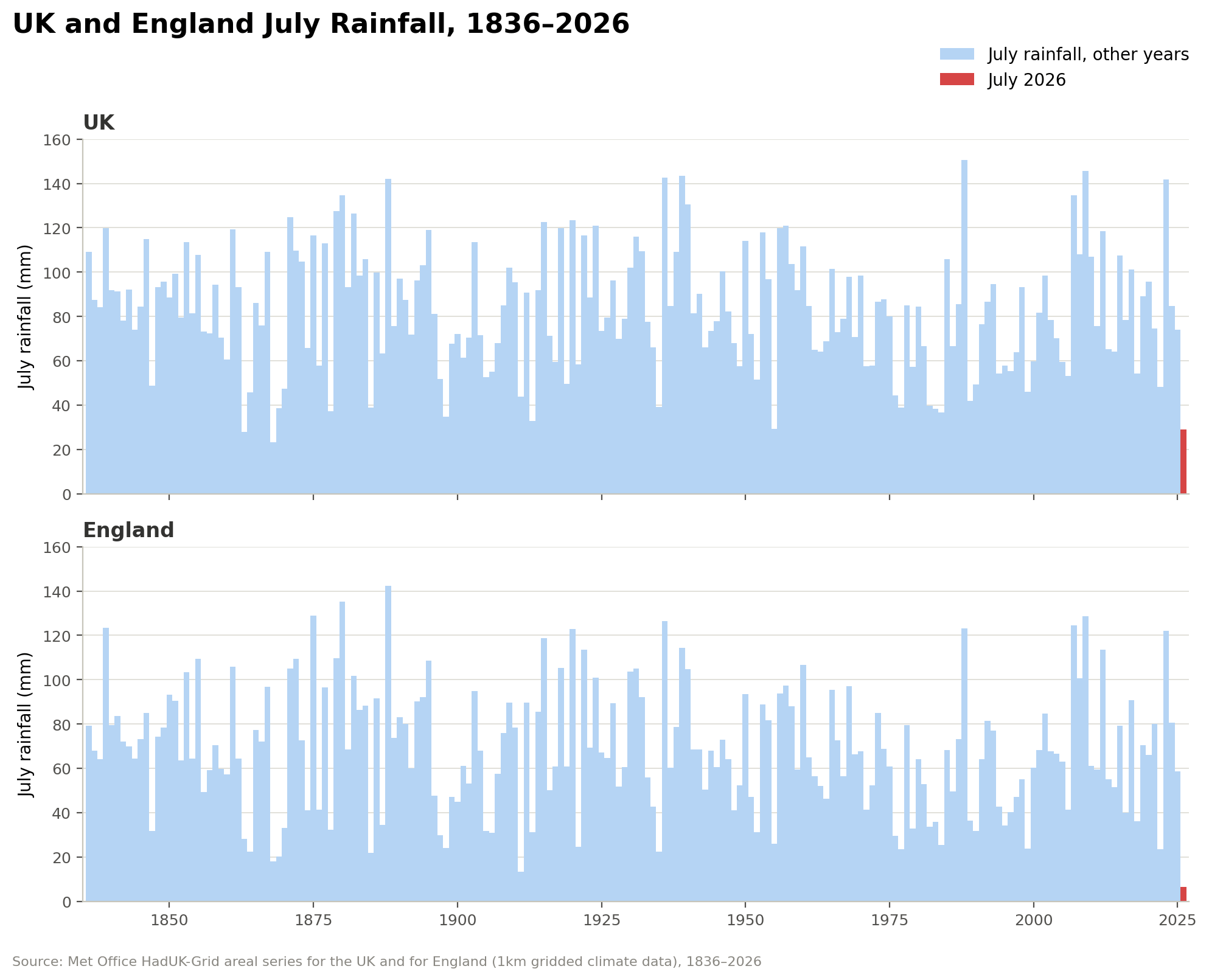
Look at data since the 1800s, and rainfall in England in July was the lowest on record, by a long way. You can see this in the bottom panel of the chart below.
The rest of the UK has had more rain (I live in Scotland, where our grass is still green), but July was still the third lowest in this almost 200-year period.
There have been drought warnings, and as climate change makes such anomalous events more frequent, this raises many concerns about how the country will cope with extreme dry spells.
The UK has been getting more rain, but mostly in the winter
The UK does not have a rainfall problem. It has a summer rainfall problem.
If we look at annual rainfall records, the country has been getting quite a bit wetter over the last century or two.
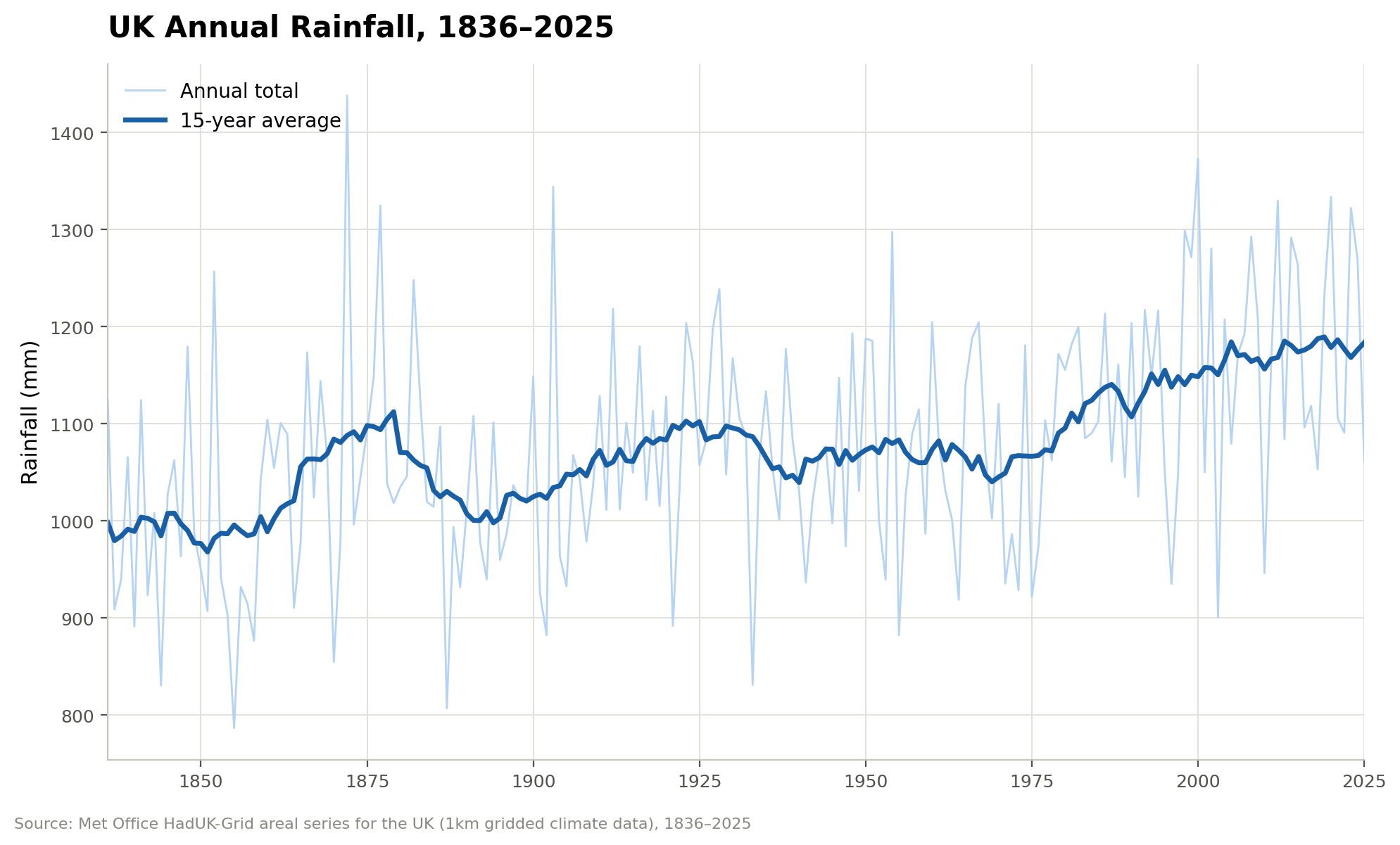
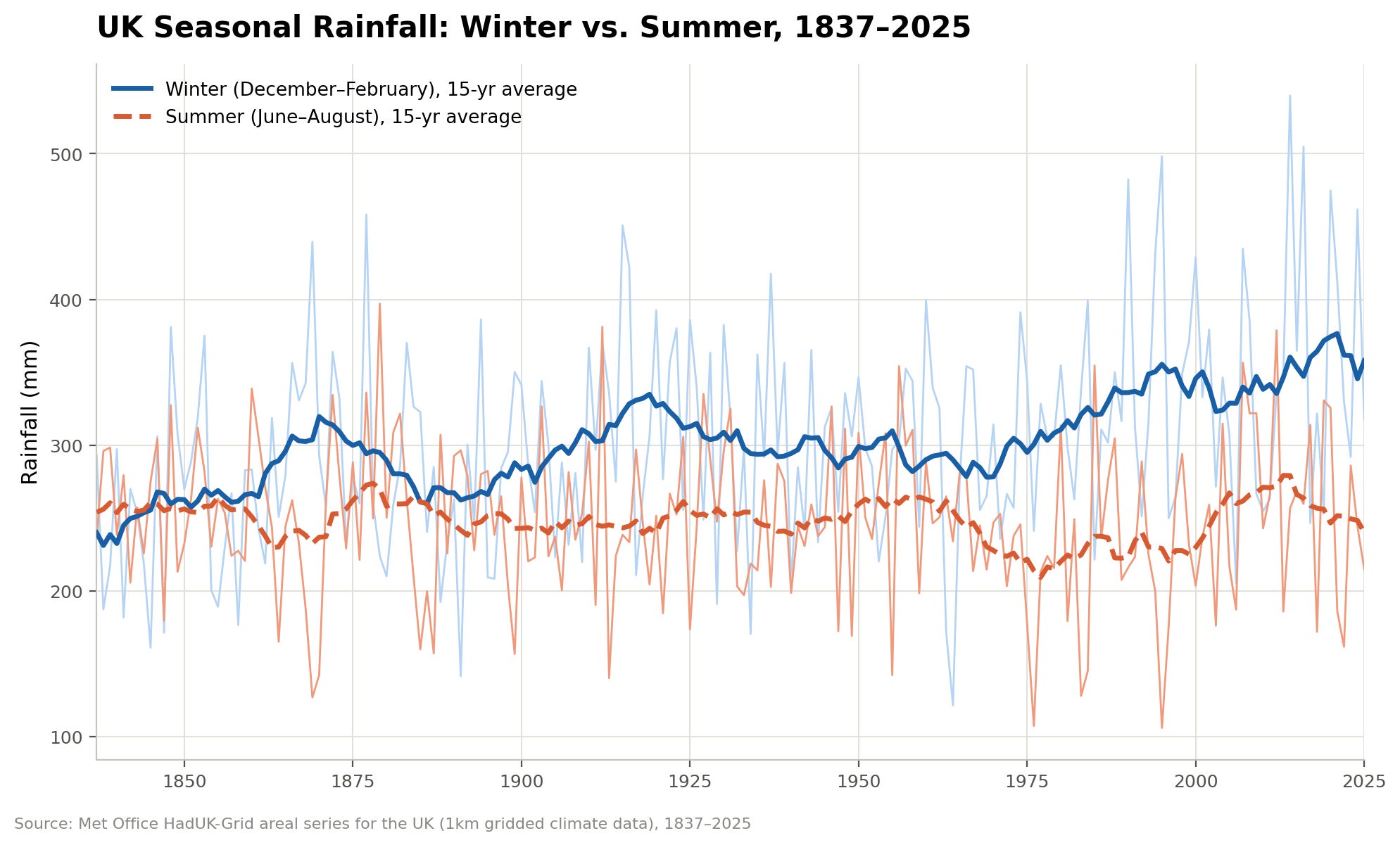
But while it’s getting more rain throughout the year, it’s becoming more seasonal. Winters have gotten wetter. Summers have gotten slightly drier.
You can see this in the chart below. The winter rise is clear. The summer trend is harder to see: it’s less a sustained decline in rainfall and more a fluctuation between quite wet and far drier periods (which partially offset the overall trend).
It’s this seasonal mismatch — not the annual amount — that’s the problem. There is, of course, a way to overcome this: store excess rainfall from the winter so it’s available in the summer.
We do this using reservoirs — basically, big holes dug in the ground to create an artificial lake. People have been doing this for centuries. The problem is that the UK has not built any in decades.
The UK has not built a reservoir in my lifetime
Okay, this is not strictly true. A small flood management reservoir was completed in Banbury in 2012.
But the last one before that (which was more than ten times larger) — built in Carsington — was completed in 1992. No others have been built since.
Below is a timeline showing when the UK’s reservoir capacity was added.1 This includes reservoirs for water supply, flood storage, and hydroelectric power. In the 1950s and ‘60s, large hydro reservoirs were completed in Scotland, which really dominate.
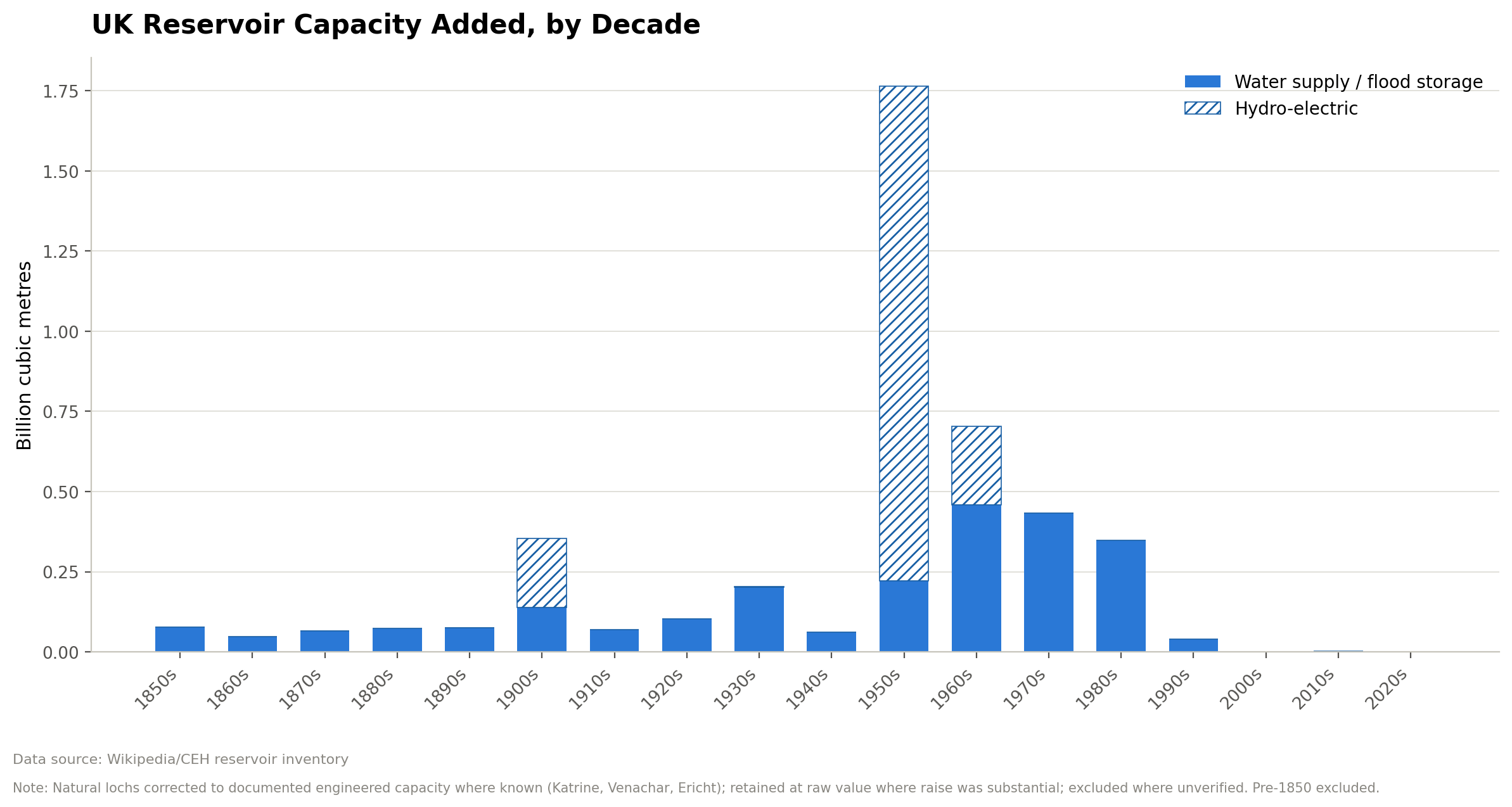
What we’re interested in here is water-supply reservoirs, so let’s take the hydroelectric ones out.
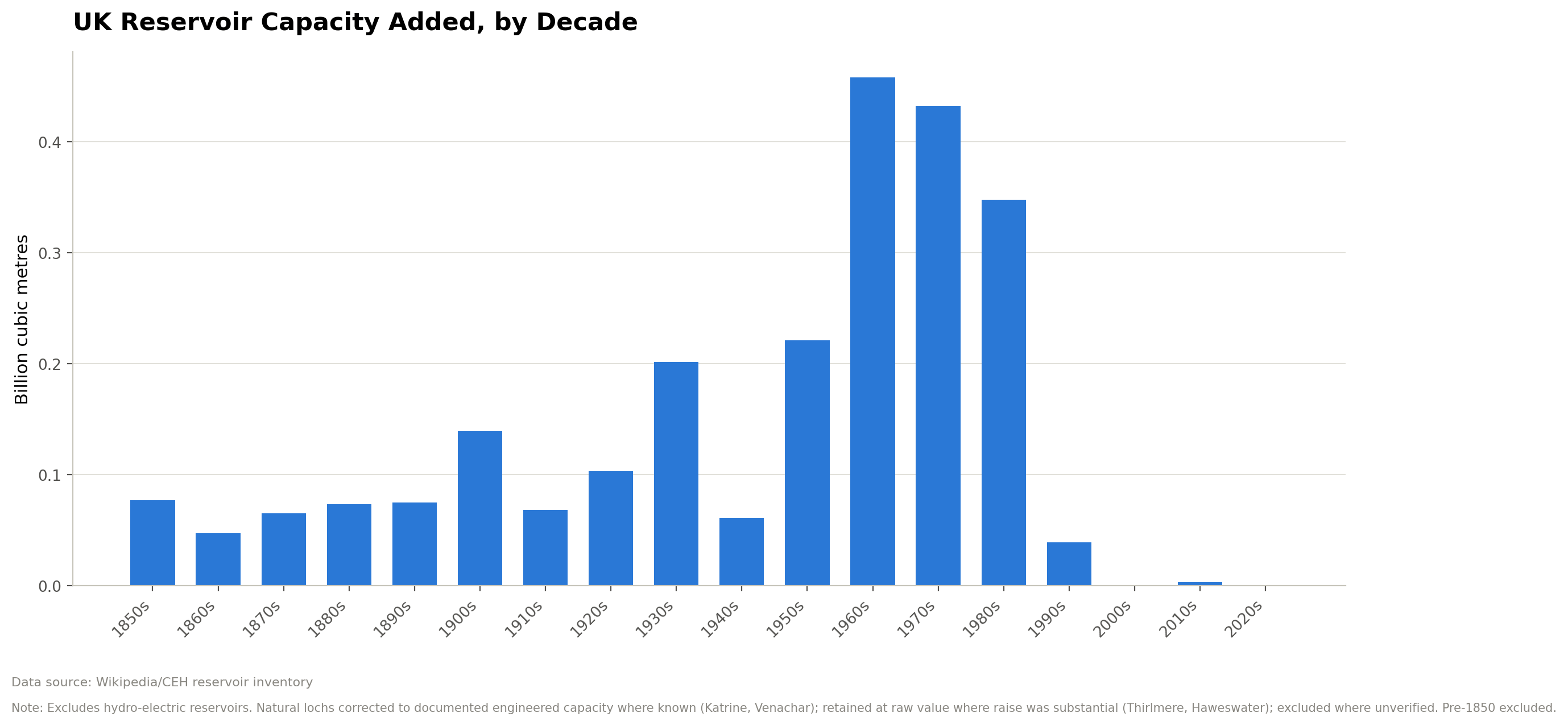
The buildout was fairly continuous throughout the late 19th and 20th century (as I said, this is not a particularly high-end technology; the Victorians were on it). A lot of reservoir capacity was built in the 1960s to ‘80s. This was not just for domestic water supplies, but also for industrial development.
The last large one — Carsington — was completed in 1992, and we’ve had three almost completely dry decades since then.
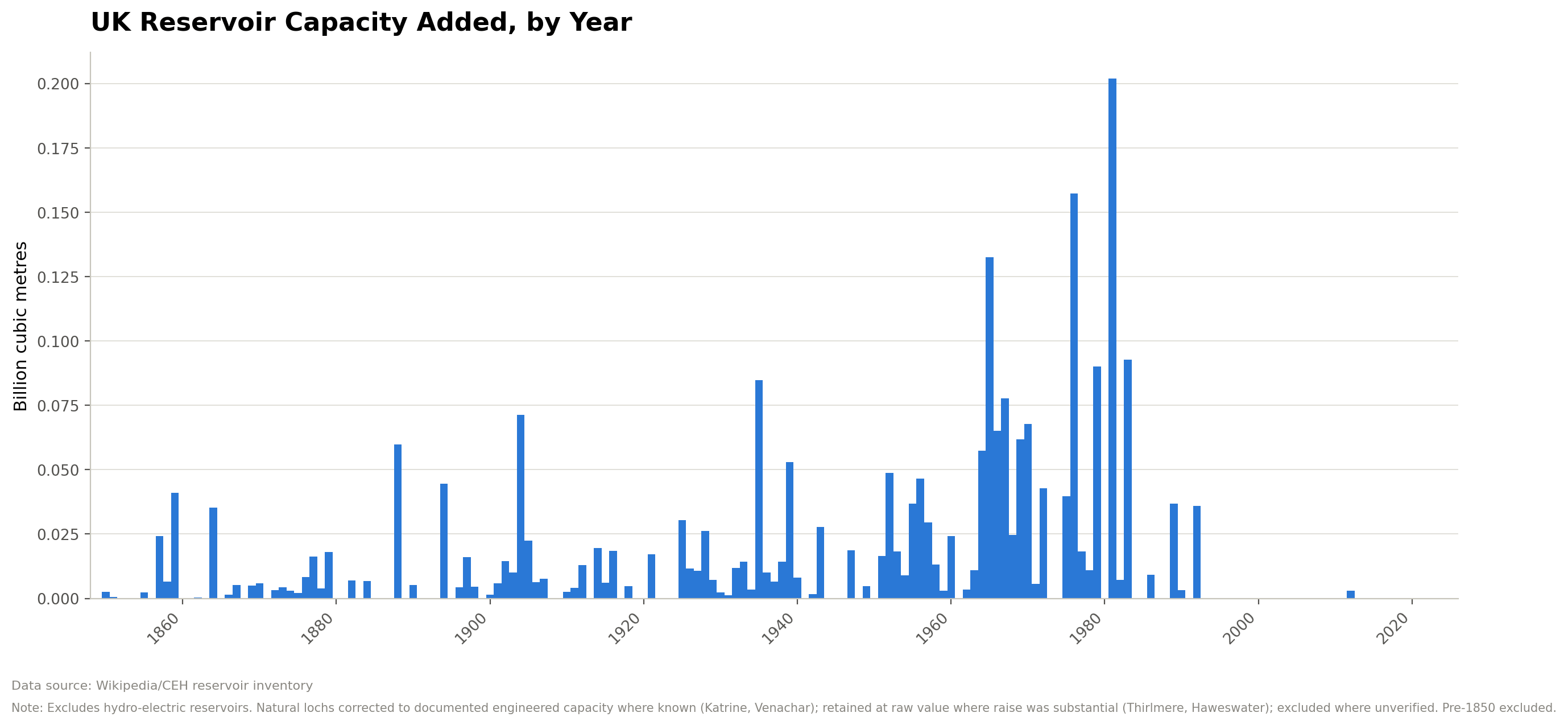
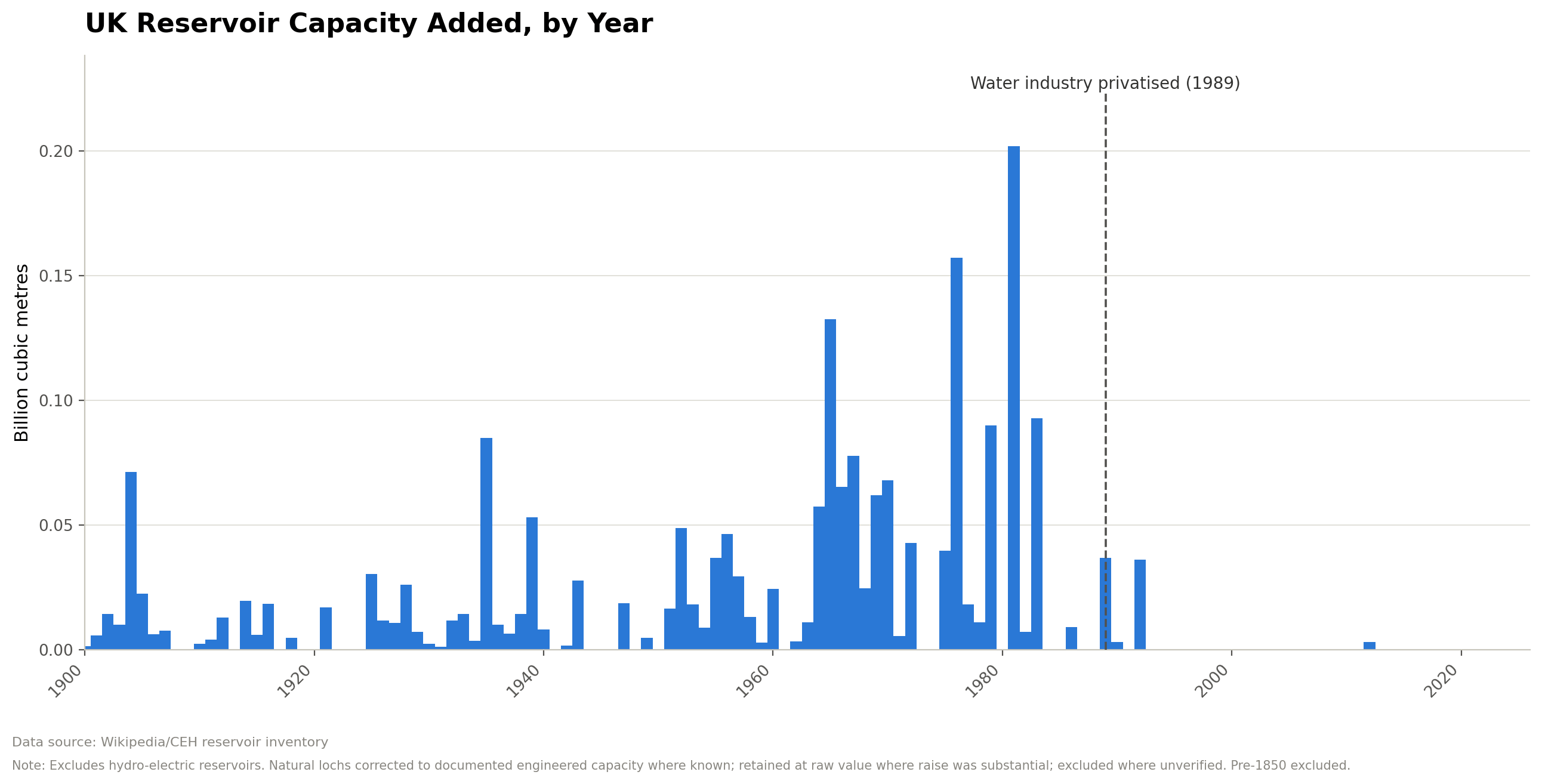
If you want this time series by year rather than decade, here it is. There were brief periods of a few years without any completions, but for most of the 20th century, each year it was more likely that reservoir capacity was added than not. Since the early 1990s? Almost nothing.
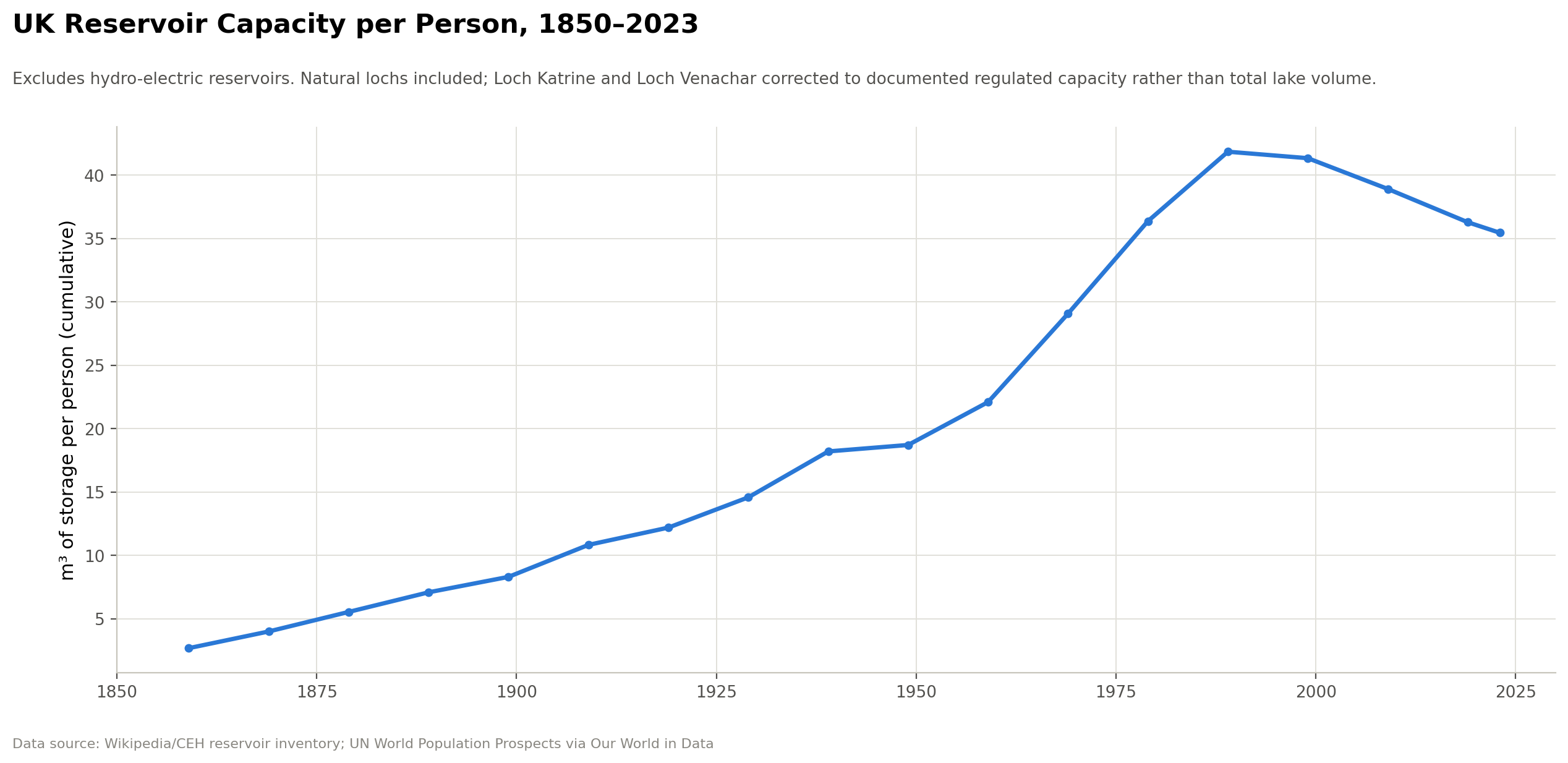
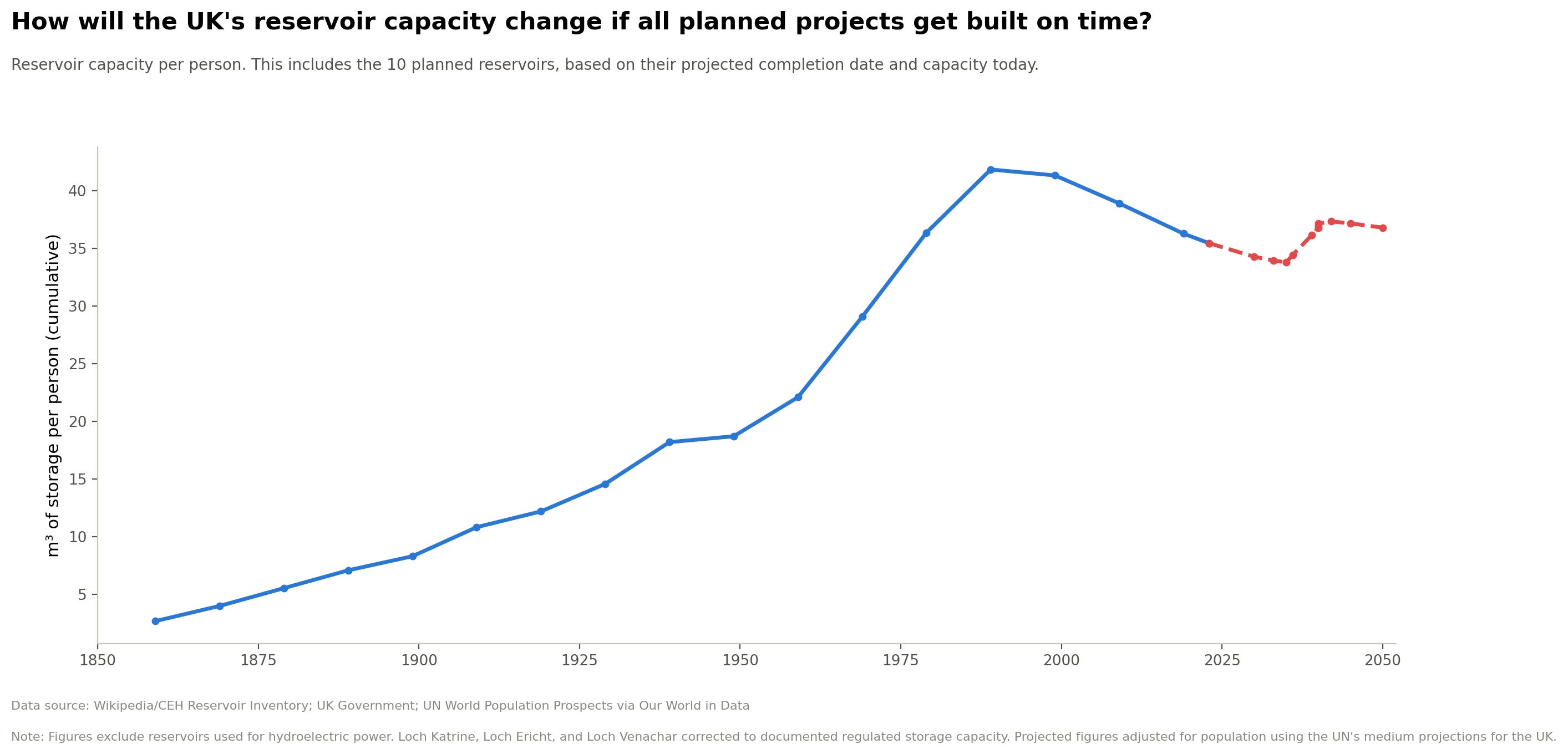
What does this mean for the amount of reservoir capacity available per person? That gives us some indication of whether supplies are keeping up with population growth.
In the chart, you can see that the available capacity per person peaked in the 1980s and has fallen since then.
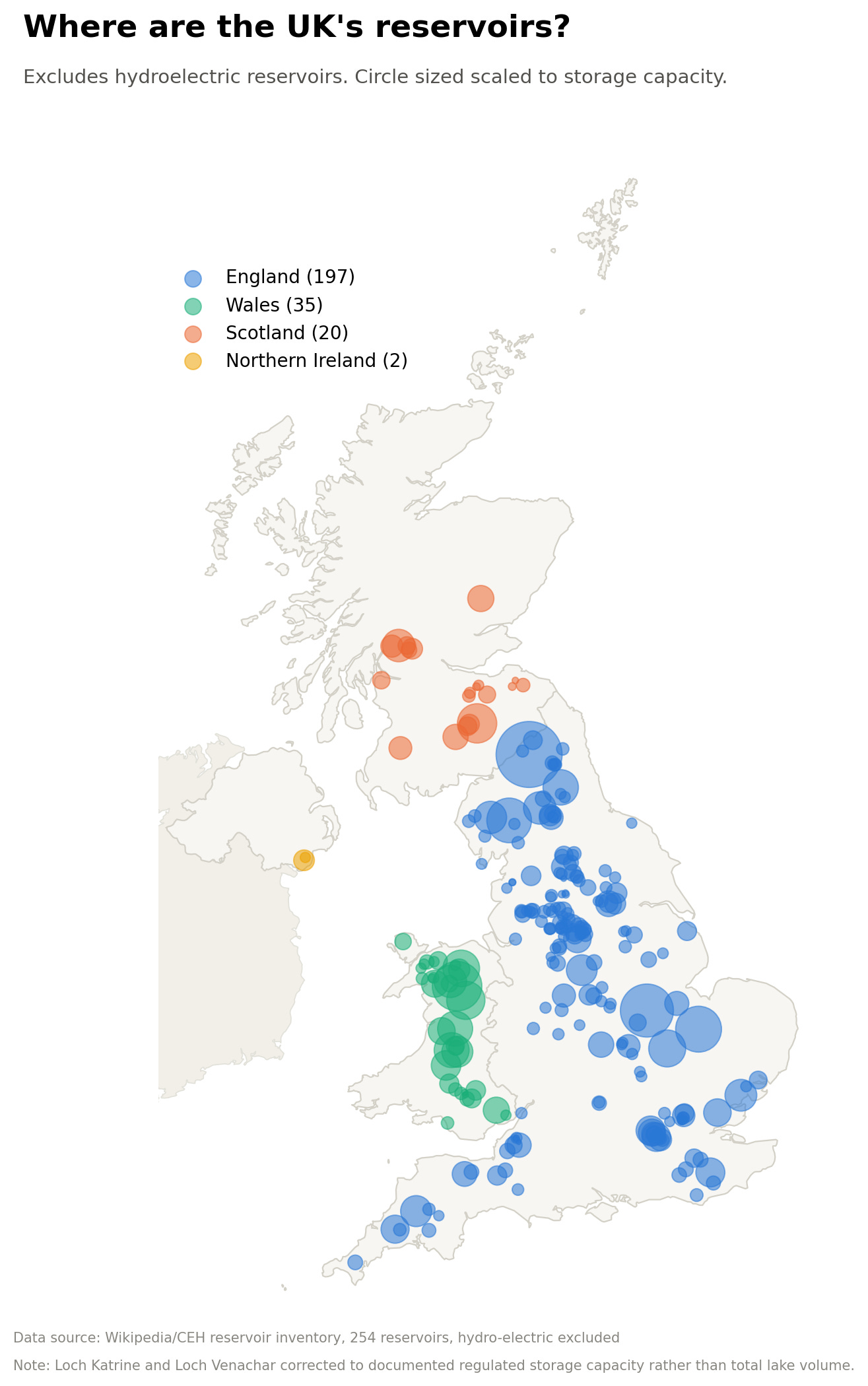
Where are these reservoirs built? Below you can see a map.
Most, as you’d expect, are in England. But they’re not exactly distributed where the population centres are. Many reservoirs were built in northern England, often to support industrial development. Some of those further north export water elsewhere. Still, there is a lack of southern reservoirs relative to the number of people who live there (and how much more prone it is to hotter, drier conditions).
Why have we become so bad at building them?
One explanation is the privatisation of Britain’s water industry. This was in 1989, which I’ve added to the graph below. The large Carsington reservoir, completed in 1992, was already underway by this point, so it’s fair to say that the country has not built a reservoir since privatisation.
The timing does look like too much of a coincidence. There is also a clear rationale for why privatisation would lead to a drought in reservoir-building. These are often long megaprojects that don’t make sense for private companies, whose performance is judged on much shorter time horizons. The incentives are just not the same.
Some think the problem lies elsewhere, blaming the planning system and Britain’s inability to build any large infrastructure projects.2
They would point to the debacle of the Abingdon reservoir in Oxfordshire. It was a £1 billion project, proposed to supply water for around 8 million people. In 2011, the government rejected the proposal, stating there was no immediate need for a reservoir of its size. Environmental campaigners also fought against it, arguing that preventing leakages in the current system was cheaper and should come first.
Not to be a boring centrist, but I would probably argue there’s some truth to both? The same incentives are not there for private companies to sink billions into long, multi-decadal projects. I think Britain has a real problem with building almost anything, from train lines to houses, and reservoirs to energy infrastructure.
It’s also true that progress has been made in reducing leakage in the current system — which is still really large — and that is genuinely cheaper in the short run. The problem is that this alone will not be sufficient. If the UK is to survive water-starved summers in the future, it will need to build more reservoirs and plug holes in our existing pipelines at the same time.
Are there plans to build more, and how will this affect water supplies?
The UK does have plans to build more reservoirs. From my searching, I found 10 in the works, but at very different stages.
Havant Thicket is a reservoir in Portsmouth that passed its planning permission in 2021, and building began this year. Its due date is 2030 (which is already later than initially planned). The rest are in their early stages. Most still need to go through public consultation and planning permission — which is where things often stall — and wouldn’t be delivered until the late 2030s or 2040s.
If all 10 projects went ahead, were delivered on time, and at the proposed capacity (that’s a lot of ifs), what difference would this make?
I’ve extended our cumulative capacity per person line out to the 2050s, assuming these all get built.3 These would need to all happen, and on time, to basically hold water supplies per person at their current levels. Fail to build, and per capita reservoir supplies will keep going down.
The first challenge is making sure all of these do get built. That will not be easy.
Reservoirs are not fancy projects. Even train lines, trams, or building infrastructure have that going for them. Reservoirs solve a crucial problem — literally having water to drink — but one that we take for granted. In a month or two, the UK will probably be back to its rainy self, and the immediacy this summer’s drought will slip from people’s memories.
People also don’t want a reservoir built near them. It’s literally a big hole in the ground, filled with water. It’s fairly disruptive, and often takes over a decade to build. The benefits to the local community are not obvious; often the water is exported elsewhere.
I don’t say this to be gloomy. But, rather, to flag that if these projects are to buck the 30-year building drought, it’ll probably take a change in approach and mentality. The long record of reservoir-building should give us some optimism that this can be done. Come on — the Victorians managed it with much less economic and engineering prowess behind them.
More reservoirs will need to be paired with reductions in leakage and more efficient demand
The government has produced an analysis of what the “water deficit” in England might be in 2050, and a strategy for how to plug that gap.
Even if these reservoirs (and other supply options, such as small amounts of desalination) get built, they’d only make up around one-third of the deficit. The rest, it proposes, will come from water efficiency and recycling improvements, and reductions in leakage (which is surprisingly large).
If the 10 proposed reservoirs keep per capita supply roughly constant, why would the country need improvements elsewhere?
Climate change is one reason. If summer droughts are likely to be more frequent, and more severe, the deficit needs to reflect that. Just as in energy, you need to plan your power system around peak demand; you cannot plan water resources for the average year, you need to plan for the most severe ones.
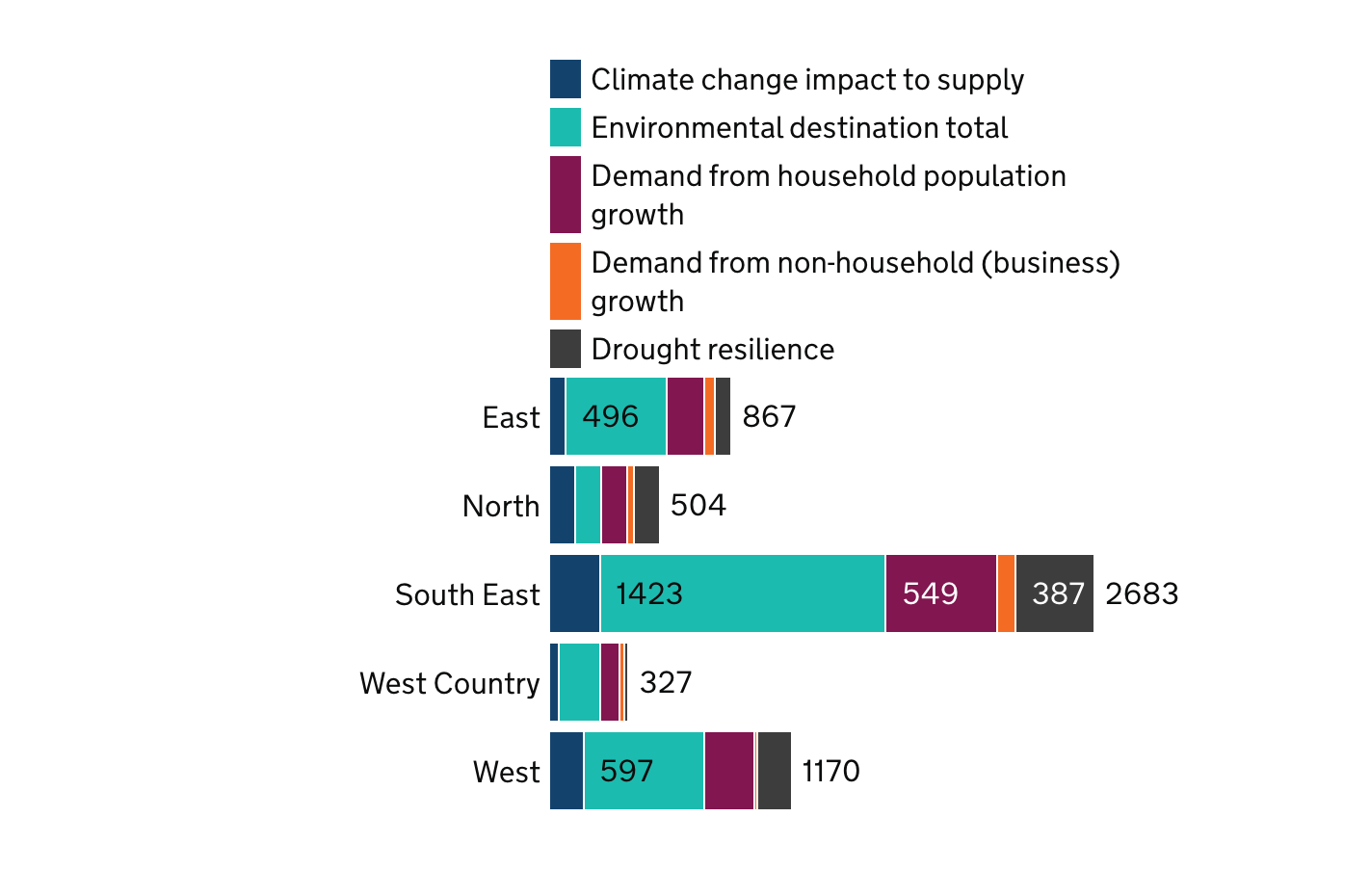
But climate change is actually quite a small driver in the government’s deficit calculations. The biggest, by far, is what it calls “environmental destination total”. It’s in the chart below.
I don’t know who named it this, or why the section on this in the report is so unclear, but my translation of this is basically “take less water out existing aquifers and rivers, that are being damaged by over-extraction”. This is particularly dominant in the South East of England (mostly London), which has very chalky aquifers. These chalk streams are quite rare globally, and support rarer forms of wildlife.
So the government’s plan is not just to fill the gap for new demand, but also to replace existing water extraction that is deemed environmentally-damaging. This is the biggest part of the so-called “deficit” (which was actually a surprise to me).
The Wikipedia page was actually incredibly useful for this. It lists the history of reservoirs in the UK, sourcing it from the UK's Centre for Ecology and Hydrology.
This was not easy to build, and for some reservoirs, it was hard to verify what was genuinely added capacity, and what was existing lake volume before. I’ve tried my best to cross-check, and think it’s approximately correct, but there will be smaller nuances for specific reservoirs.
Since this chart is focused on the construction of reservoirs, I’ve adjusted a few of the numbers from their original figures, which not only included the reservoir capacity “added”, but the entire capacity of, for example, a natural loch.
The obvious example is Loch Katrine, which appeared in the 1850s decade. Most of this was not additional constructed capacity, so would give the false idea that more was “built” than was in reality.
The Ericht dam for hydroelectric power is another example, where the operational capacity is quite different from the total lake volume. I think there are some others in the hydroelectric bar for the 1950s that are possibly too high, but I couldn’t find solid data on the different between lake volume and operational capacity for each. Since this article is about non-hydro reservoir capacity, it doesn’t make much difference to the conclusions.
https://en.wikipedia.org/wiki/List_of_reservoirs_in_the_United_Kingdom
https://catalogue.ceh.ac.uk/documents/f5a7d56c-cea0-4f00-b159-c3788a3b2b38
Again, there is the very small one in Banbury, which opened in 2012.
This is generally the position of think tanks such as the Centre for Policy Studies.
Is it possible to break the data down by region? The UK has seen its annual rainfall increase, but is this true for somewhere like Kent?
https://www.wildlondon.org.uk/nature-reserves/woodberry-wetlands
A lovely place to visit - perhaps a model of how to run a reservoir that people view as a comunity asset rather than something to oppose?