

It’s hard to believe that it has been almost a decade since Hans Rosling died. He was a huge inspiration for the work I do today.
He would also be appalled that more than ten years on from his big push to make international organisations share valuable data with the world, some are still not doing it.
He coined the term “database hugging disorder” for this behaviour. One of the organisations still inflicted with the disease is the International Energy Agency (IEA). Despite being mostly publicly-funded, it makes users buy a license to access and use many of its crucial datasets.
You might have heard me beat this drum before (we’ve written about this on Our World in Data, and I’ve written about it in Nature), but I’m here to bang it again because I still find the whole situation insane and indefensible.
I should start by saying that I think the International Energy Agency does fantastic work. It collects and produces invaluable data on energy systems across the world. I find their reports insightful. I’m glad that it exists.
It’s because their work is so valuable that locking it behind paywalls is so frustrating. If it were rubbish, I wouldn’t care.
To understand why the current situation is so mad, let me try to explain how the IEA is funded, and how it makes its money.
The IEA is a mostly publicly-funded organisation
The IEA was set up in the 1970s by OECD countries. Today it has 32 member countries.
In 2018, the IEA’s annual core budget was around €28 million. Most of this money comes from funding from these member countries.
The remainder comes from revenue from selling its data and publications to users. It previously said that these sales were “more than one-fifth of its annual budget”. That would have been around €6 million a year.
I couldn’t find more recent public figures, but based on this data and other conversations, I still think €6 to €10 million a year is probably in the right ballpark.
It’s worth noting that most of its revenue comes from taxpayers in its member countries. So, we pay taxes for it to do most of this work (again, I’m very happy for a small slice of my taxes to be spent in this way), and then we have to pay the IEA again to access the data it produces.
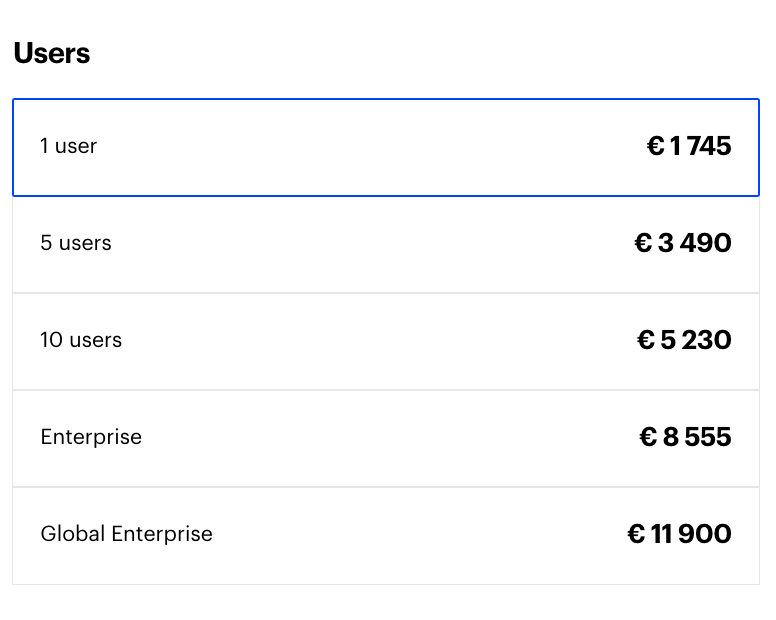
These licenses are not cheap. A user license costs thousands of euros. Once you’ve bought one, you’re not allowed to share the data or any analysis that relies on it.
I get that the IEA is in a bind here. It needs to be financially sustainable, and any shortfall in funding must be made up in another way. But the member countries financing it are shooting themselves in the foot; rather than just slightly increasing their budgets to cover the remaining fifth, they massively limit the benefits of the funding they do provide. This paywalled data is a drag on scientific progress, public discussion, and a huge waste of researchers’ time.
Why does it matter that the IEA’s data is paywalled?
Why the fuss? If the IEA’s data needs a license, use another source instead.
Well, we do. We patch together what we can. The problem is that it doesn’t have all of the metrics and coverage we’d want.
At Our World in Data, we rely on Ember for electricity data; it does amazing work and makes this freely available.
But total energy data (beyond electricity) is a problem. We rely on the Energy Institute. This was formerly the BP Statistical Review; so yes, researchers often relied on free data from an oil giant to understand global energy. I’ll repeat: the situation is a bit insane.
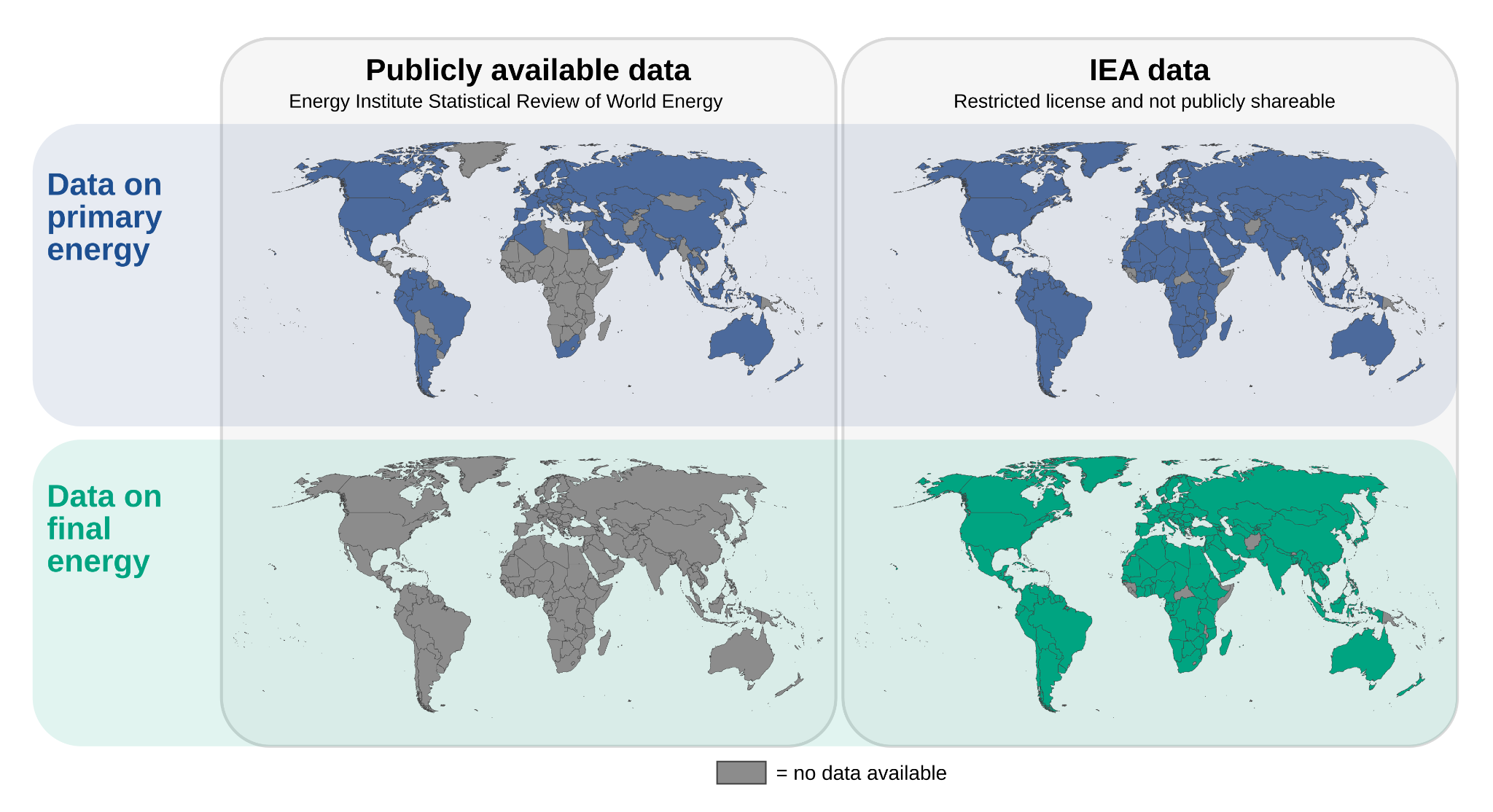
This does produce freely available data on primary energy. But it lacks geographical coverage (especially in lower-income countries) and does not produce any data on final energy. These other energy metrics are crucial for an informed discussion of energy and the transition, and they are completely missing. Below is an updated version of a chart we made on this.
I’d love to show better global energy data, but I can’t, as long as the IEA keeps its paywalls.
This is a terrible situation for several reasons.
1. No money? Sit this one out. Those from lower-income countries are completely locked out of the conversation. They’re often missing from available free datasets, and researchers, institutions and students in these countries might not be able to fork out thousands on an IEA license.
2. It is a complete waste of researchers’ time. They spend stupid amounts of time trying to figure out what data they can share (so they don’t get sued) and find workarounds, or other sources they can. In one of the craziest examples, I’ve heard that authors on the Intergovernmental Panel on Climate Change (IPCC) have to dedicate frustrating amounts of time figuring out what energy data they can use, in what format, and if they need to find alternatives.
3. There is no scientific transparency. Scientific progress relies on others being able to investigate results and replicate analyses. Anyone relying on IEA data cannot share the underlying data in academic work. The IEA and the work it underpins do not adhere to the basic principles of scientific transparency and replication.
4. It makes for poor public discussion. We’re in a crunch period of the global energy transition. We’re in a turbulent period of energy price hikes and supply shocks. To have an informed public, this data is crucial. Instead, it’s in a locked database that very few people can access (and cannot share). This is not defensible.
To quote the IEA’s own mission:
“The IEA is at the heart of global dialogue on energy, providing authoritative analysis, data, policy recommendations, and real-world solutions to help countries provide secure, affordable and sustainable energy for all.”
By global dialogue, I have to assume it’s the only dialogue among elites who can afford a license. Its own structure undermines its mission.
What can be done?
I feel slightly bad writing some of this because I know that those within the IEA do not want this to be in this situation. When we kicked up a fuss about this a few years ago, they were very supportive of efforts to try to improve the status quo.
In 2022, it looked like the situation might change. The executive director proposed to make all of its data free, with the support of the governing board. But when the ministers of member countries met to discuss, they couldn’t agree. They asked to review options to make more data free (while offsetting the implications on its budget).
They have made some of their data and publications free since. But not all of them, and not many of the biggest and most important ones.
How could we get there?
I have little faith that the member countries themselves will plug the gap.
One option might be for a generous, wealthy donor to buy out the shortfall for a certain number of years. One or two years probably wouldn’t be enough; member countries would argue that this model isn’t sustainable, and they’d be left to cover the shortfall in the future.
Maybe 5 or 10 years would be sufficient? If the revenue from sales is really in the order of €6 million a year, that would be €30 million over five years, or €60 million over ten.
That sounds like a lot, but compared to total philanthropic spending, these numbers are not crazy.
And with some large tech companies (Anthropic being one) having filed to go public, there is the chance that some very wealthy people have a lot more money to fund useful things.
I’d like to throw free IEA data in the ring for consideration.
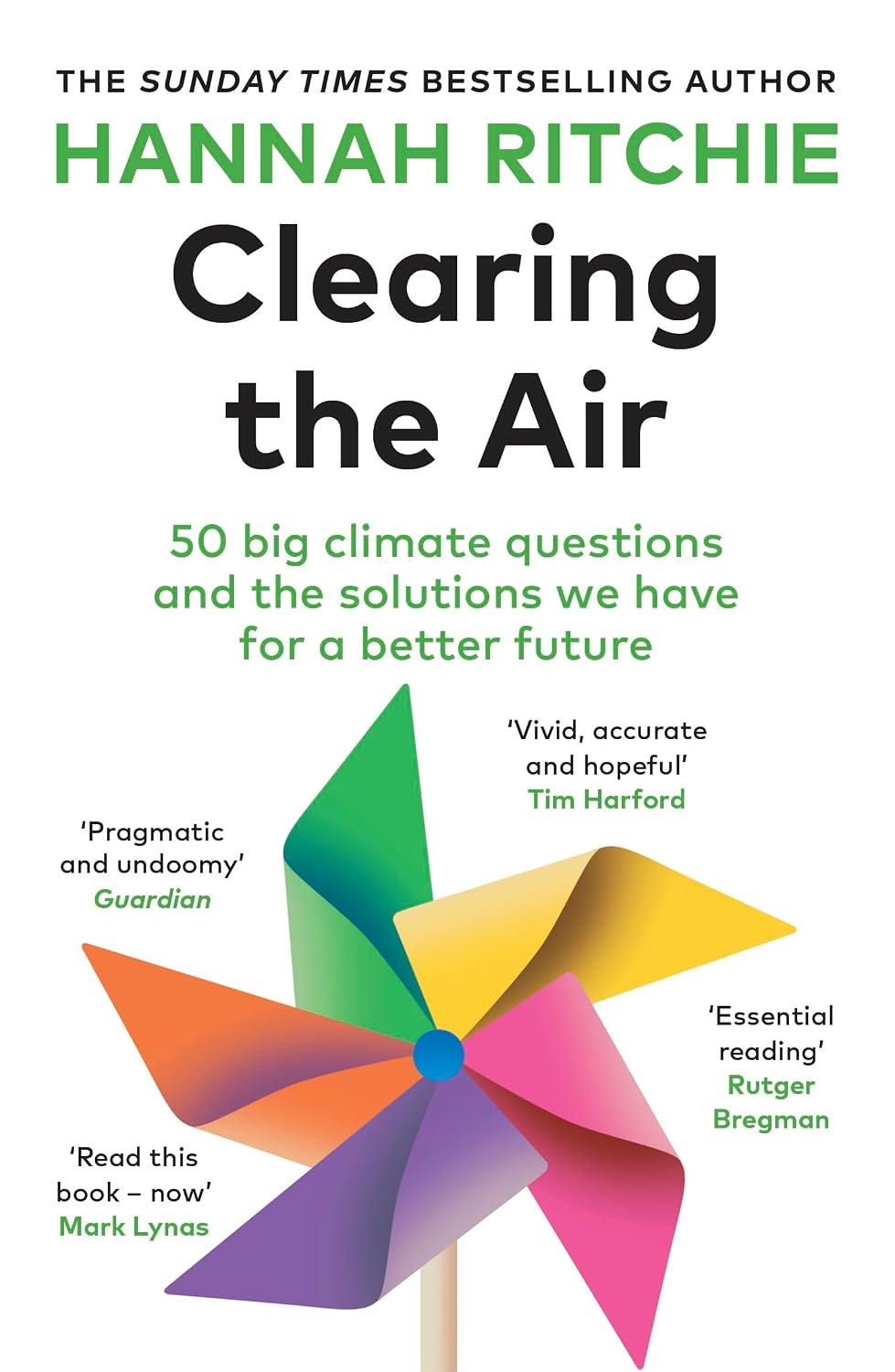
📚 This month, my book Clearing the Air is basically free on Kindle. You can get it for just 99p for all of November.
It mirrors a lot of the things I publish on here (for free). If you like this newsletter, I’m confident you’ll find it interesting (and have lots to debate after reading it).
Don't ever stop banging that drum Hannah! Publicly funded entities should be forced to release their data, similarly for government and governemental agencies.
Public agency data should never be paywalled.