

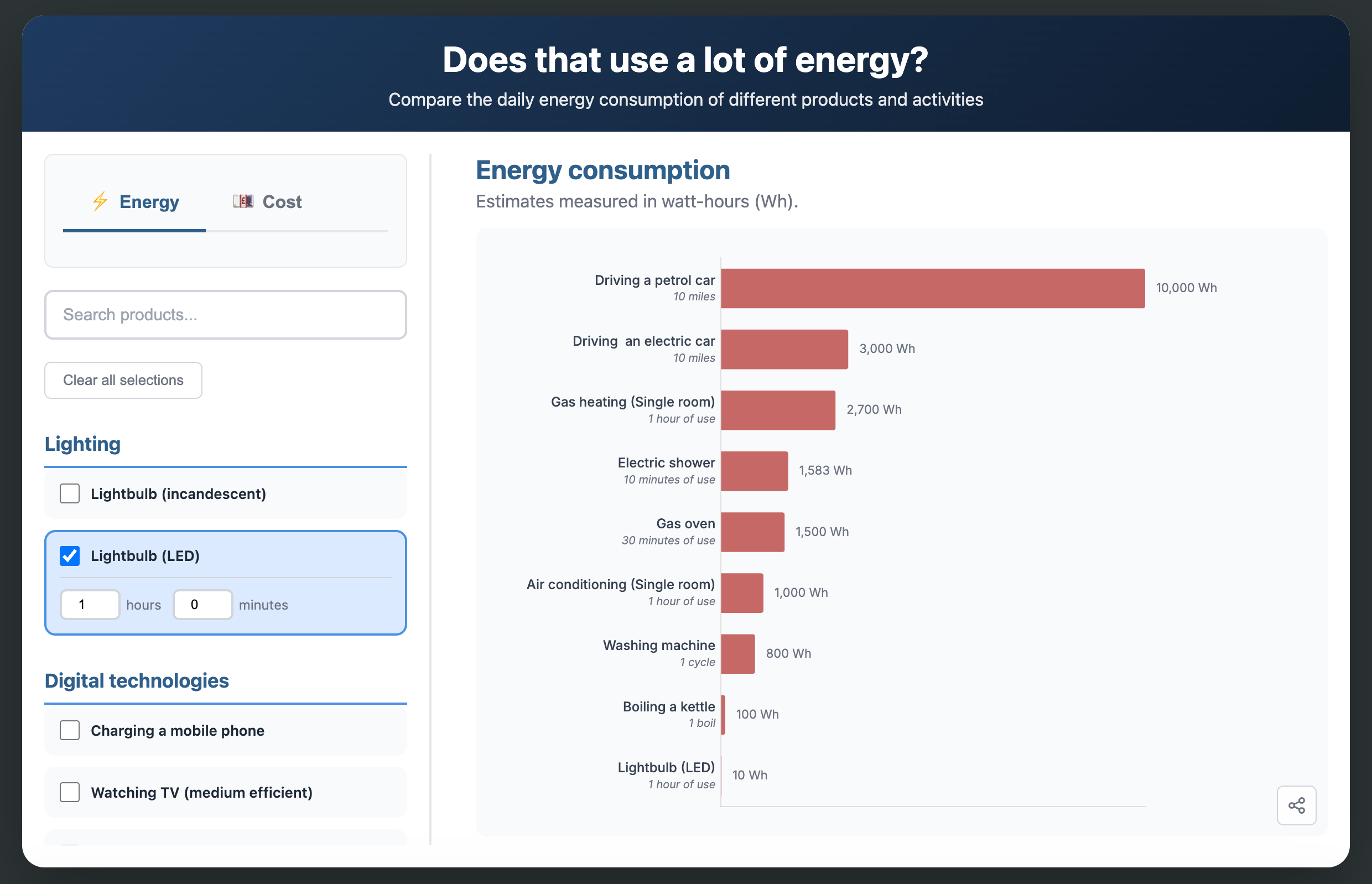
A couple of weeks ago, I published a prototype tool that allows you to compare the energy use of different products and activities.
The motivation for this was simple: it’s extremely hard to get a sense of magnitude for how things compare, and I know people struggle with this a lot. That affects what people prioritise, and is a problem for public discussion. We get countless headlines focused on the energy saved from “deleting emails” or streaming Netflix, and not enough focused on swapping a boiler for a heat pump.
I asked for feedback on how I could improve it, and I got a lot of responses. Thank you to everyone who engaged, commented, and emailed.
I’ve spent some time over the last few weeks addressing many of these comments. For various reasons, I couldn’t implement all the suggestions (some would make things too complex, which goes against the point of the tool), but I did make quite a number of improvements.
In the tool, I’ve included a “Change log” which details the changes that I’ve made along the way.
Perhaps the largest and most visible one is that I’ve tried to provide a rough sense of energy costs for a selection of countries. That is often more meaningful to people than the number of watt-hours they’re consuming.
I’m still very open to more feedback (especially if you think something is wrong!), but I won’t be as active in changing things as I was this time around.
I hope it’s useful for you in some way. Feel free to use it and share.
Nice tool.
One thing I’ve observed is that, before talking to quite a few people about how much energy something uses, you’d have to address the myth that this or that thing takes so much more energy to be turned on than to stay on that you’re better off leaving it on for the better part of a day than switching it off and on again.
I first heard it about desktop computers, when I was ignorant enough about them to make this belief plausible, and then, nearly twenty years later, about lighting. This time, I was aware of both the absurdity of the claim and the futility of replying to the person making it—the real meaning was “I’m in charge—I get to decide what passes as true here, when and for what purposes”.
This must have been pretty expensive in the good old days, with energy-inefficient desktop computers and incandescent light bulbs. Talk about luxury beliefs.
Thank you for this simple yet powerful tool!
Unless, I missed something obvious, I see no place to change the cost of electricity or the fossil fuels. In the US, there can be huge disparity between states in the prices of electricity. Please consider adding the ability to change the unit costs of fuels.