

This weekend, Brazil’s current president, Lula da Silva, will head to the polls against Flávio Bolsonaro (the son of former president Jair Bolsonaro). It looks like the election will be incredibly tight.
I can’t speak to all of Lula’s record, but there is one area where he has made a clear difference: in reducing deforestation in the Amazon.
The latest annual estimates of deforestation were recently published by Brazil’s National Institute for Space Research (INPE). Its PRODES project uses satellite imagery to monitor the clearing of forest in the Legal Amazon. You can find this data here.
It estimates that deforestation over the past year (from August 2025 to July 2026) was around 3,300 square kilometres (km2).
As you can see in the chart below, that’s a substantial fall from last year, and the lowest since records began in 1988.
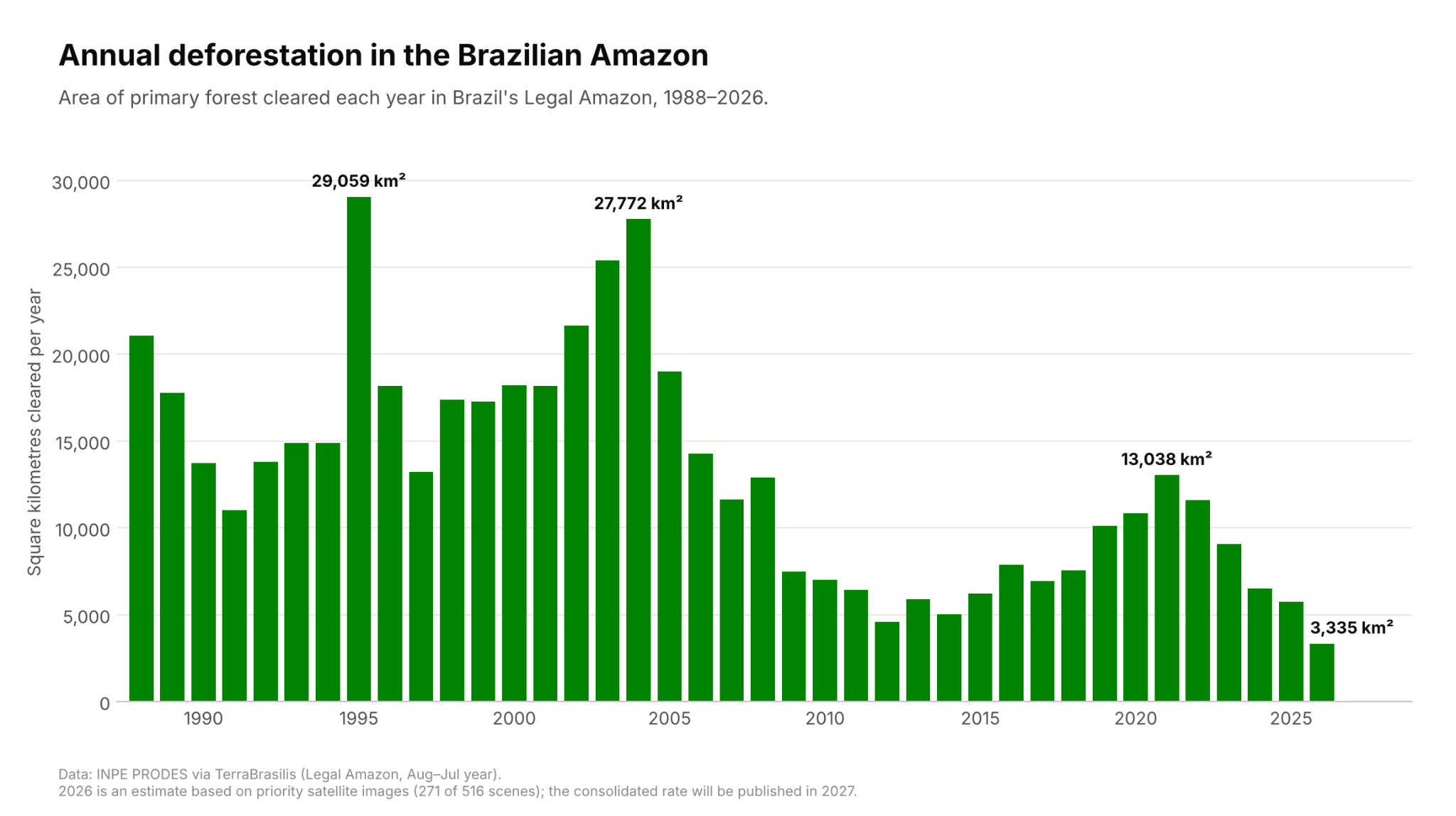
Deforestation rates in the Brazilian Amazon have gone through various waves in recent decades. Lula has been quite central to some of them.
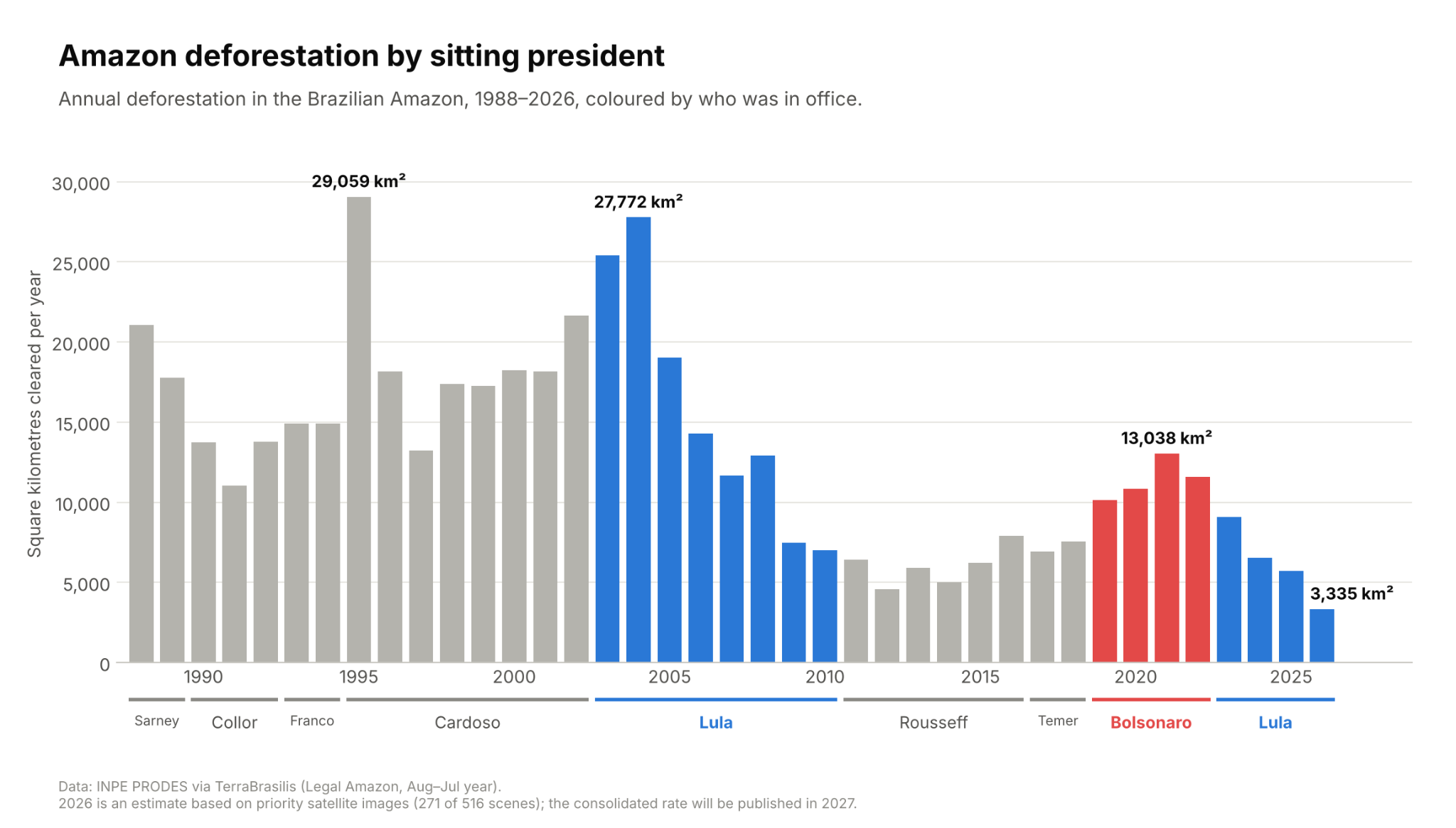
I’ve plotted the same data — annual deforestation rates — but with the bars labelled by which president was in office at the time.
Lula was president before, during the first decade of the 2000s. During his term, deforestation rates fell by three-quarters from their peak. They remained relatively stable during the next two presidents’ terms, but increased again under Jair Bolsonaro. You can see this in red.
These “peak” rates in the early 2020s were still half the rates of the early 2000s, but much higher than they had been over the previous decade.
Under Lula’s current term, they’ve fallen by roughly three-quarters again. Credit where it’s due, his government can reduce deforestation.
Four decades of Amazon deforestation in perspective
Less deforestation in the Amazon is something to celebrate.
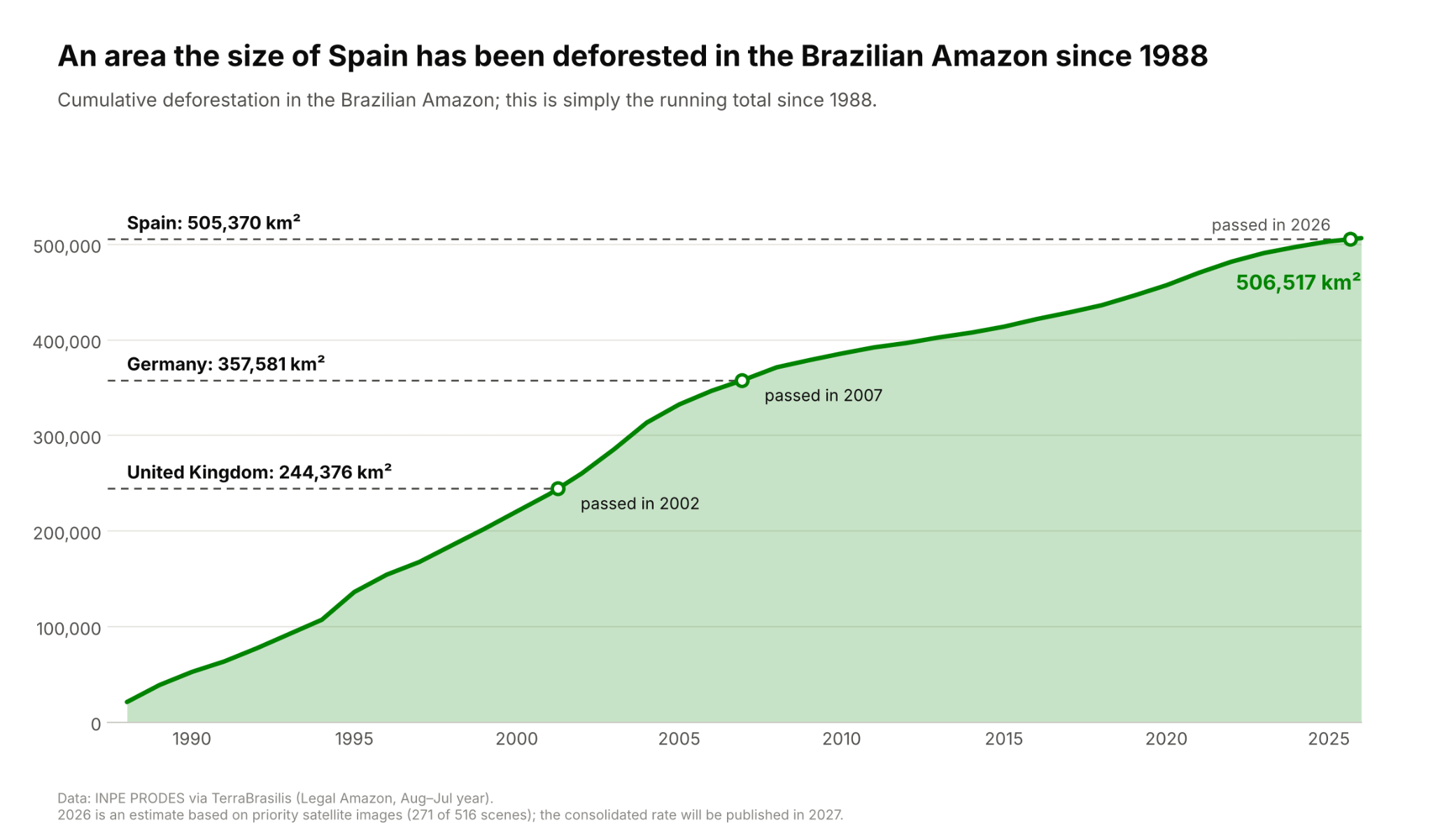
But, of course, any deforestation means the total amount of forest lost continues to rise (just at a slower pace). When I posted an annual update last year, I noted this, but readers quite rightly told me I should make a chart. Here it is.
It shows the cumulative area of forest lost in the Brazilian Amazon since the start of this series, in 1988. By the early 2000s, an area the size of the UK had been lost. Just five years later, it was the size of Germany. And this year, it will have grown to an area the size of Spain.
That’s a lot of native forest — and rich ecosystems — lost. And until deforestation ends, this area will continue to grow.
For context, it’s estimated that around one-fifth of the Brazilian Amazon has been lost.1
Deforestation in the Cerrado has also fallen
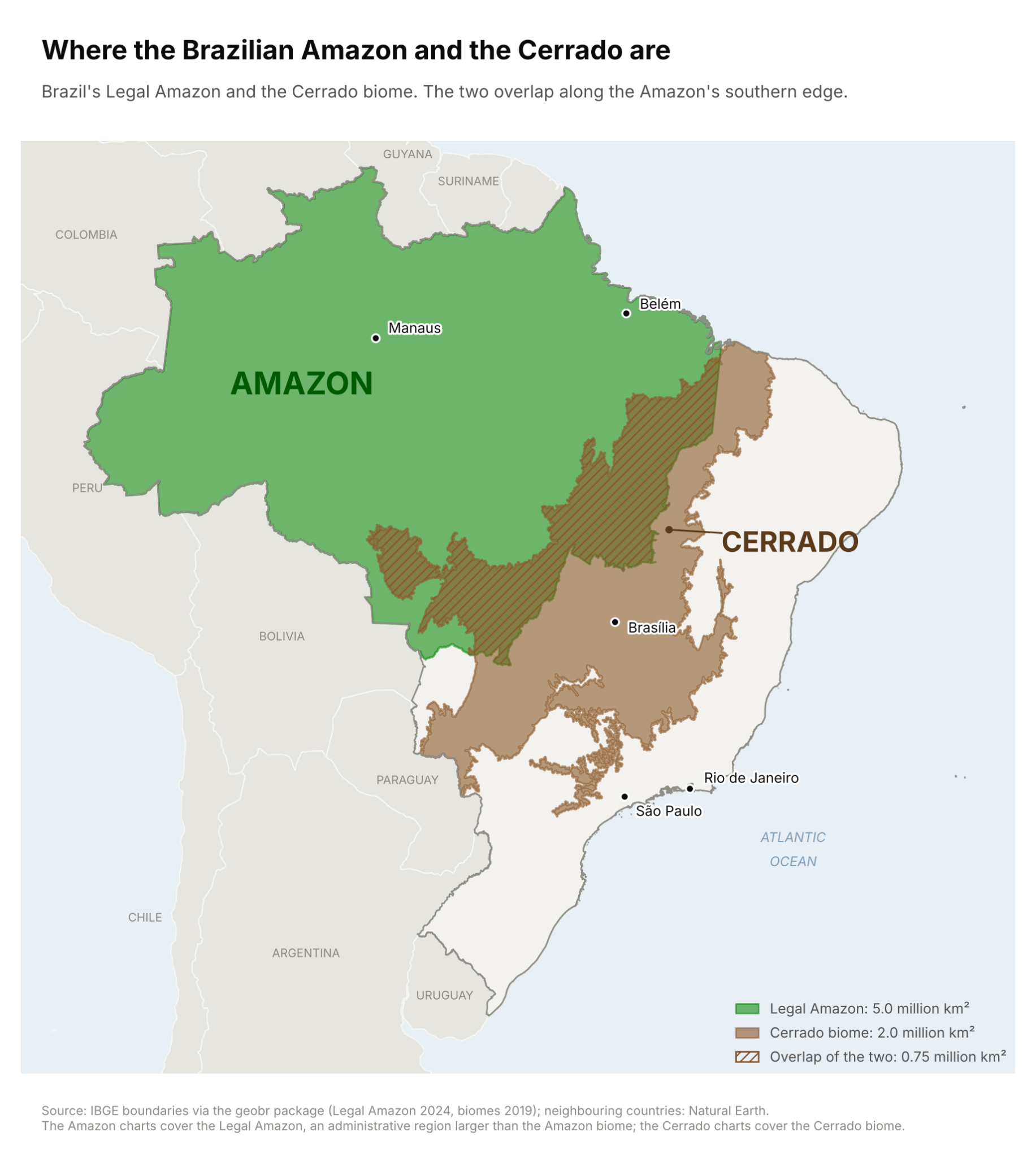
The Amazon gets most of the attention. But Brazil is home to other diverse, important vegetation biomes.
One of those is the Cerrado. It’s a mosaic of forest, woodland, and grassland. Here is a basic map so you can get your bearings.
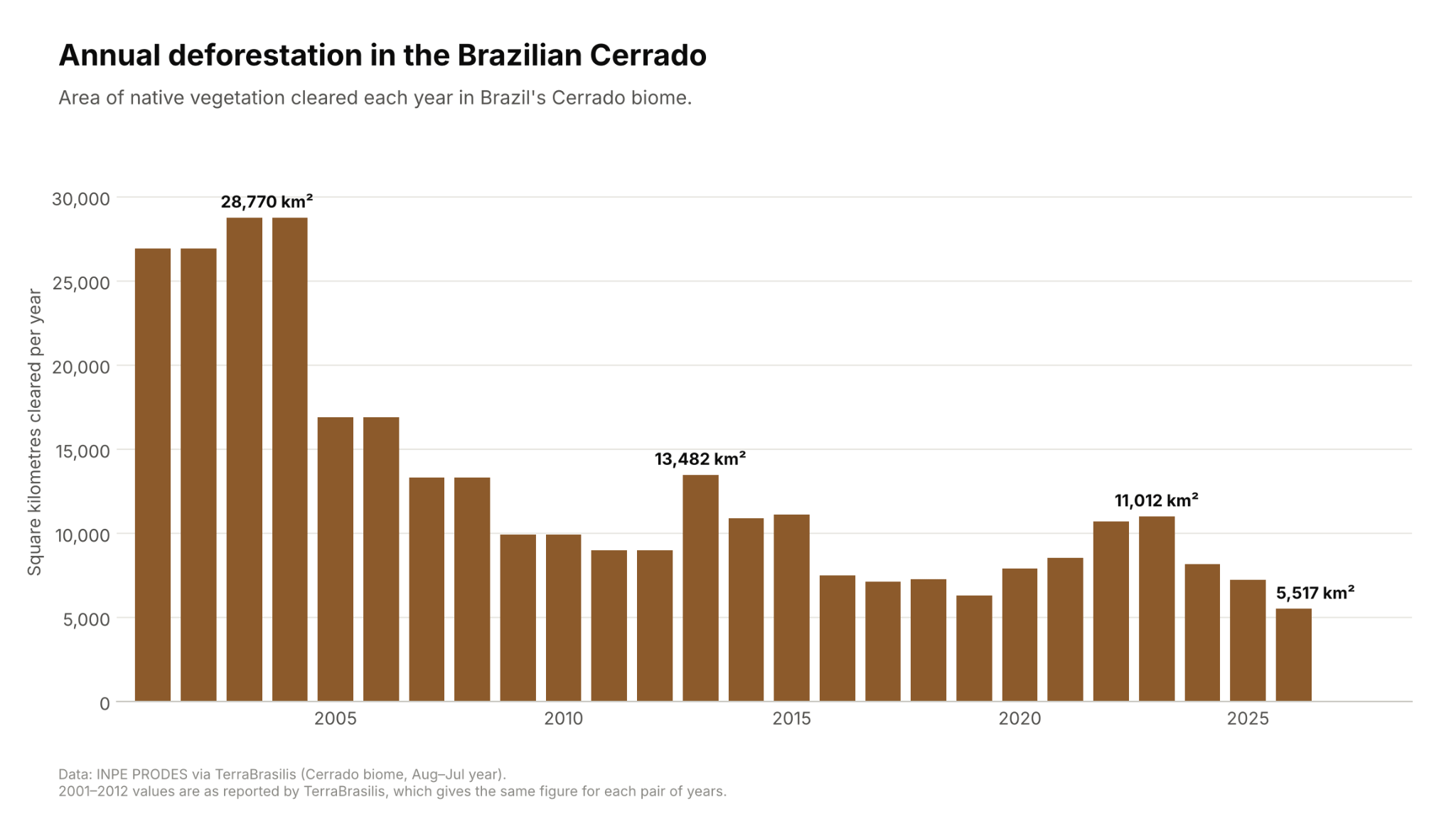
In most years, more forest has actually been lost there than in Brazil’s Amazon. That was true again last year.
But it was also a record low in the Cerrado since records began in 2001 (its time series is shorter than the Amazon’s). You can see this in the chart below.
There’s therefore no sign that deforestation in one key region has just been pushed to another.
Messias, C. G., de Almeida, C. A., Silva, D. E., Soler, L. S., Maurano, L. E., Camilotti, V. L., ... & Adami, M. (2024). Unaccounted for nonforest vegetation loss in the Brazilian Amazon. Communications Earth & Environment.
This estimate focuses on deforestation. Other areas of the forest have undergone degradation, so the loss of intact forest is higher.
One thing all the deforestation stats seem to ignore, perhaps because there is no easy fix, is how much deforestation would have occurred today if the amount last year was as it was at start of the series. When much of the forest has already been removed it stands to reason, future deforestation rates will tend to fall..
Great chart work, as always. Lowest year since 1988, and the Cerrado down too. That is real news, and it is good to see it laid out plain.
The long view helps too. Even with the fall, the total lost since 1988 is now about the size of Spain. Both things are true at once. The rate can drop and the hole still grows.
Holding the gain is the hard part. Demand for land and wood does not stop. Any supply that meets that demand without clearing new land helps the trend hold.
Thanks for tracking this year after year. Work like this is how people can check the story for themselves.