
Technology can cut plane contrails by two-thirds. Getting airlines to use it isn't so easy
Flights that followed an avoidance path cut contrails by almost two-thirds. But getting dispatchers and pilots comfortable with these routes will be crucial.

One of the cheapest ways we could limit global warming today is by reducing aviation contrails.
I’m not going to go into the mechanics of contrails — what they are, how they’re formed, and how they drive global warming — here, because I covered this in much more detail in another Substack. If you’re new to this topic, I’d suggest you read that one first for context on why this matters:

But the core of my argument there is that contrails — which are around 2% of the world’s effective radiative forcing — could be reduced quickly and cheaply.1 We will need to find low-carbon alternatives to jet fuel, but that will take time, and it will be expensive. While the aviation industry works on that, it could substantially cut its climate impact at a relatively low cost.
By “low cost”, I mean it could be a few dollars per tonne of CO2e and per passenger.
While this all sounds promising, a lot of this thinking has been based on modelling: how many flights could avoid the atmospheric conditions that create contrails, whether that would actually reduce contrail formation, and how much extra fuel would be burned in the process.
A few years ago, Google partnered with American Airlines to run a real-life “proof of concept” showing that AI combined with satellite imaging technologies could actually help pilots reduce contrails. They did this across 70 test flights, reducing contrail formation by 54%.
This showed that it was technologically feasible, but on a limited scale.
Google have just published the results of a larger trial, involving thousands of flights. I think these results tell us something interesting about the feasibility and the hurdles to getting this to work at an industry scale.
The trial involved around 2,400 American Airlines eastbound transatlantic flights; those flying from the US to Europe. These flights were deemed to have a substantial impact on warming through the contrails they’d generate on their standard route.2
Around half were in the control group and were not given any flight plans to help them avoid conditions that would generate contrails.
For the other half, plane dispatchers had two options: the standard flight plan and an alternative contrail-avoidance one. They could then make their own decision on which one to allocate and hand over to the pilot. This was completely voluntary; there was no obligation or incentive to choose the avoidance option.
The headline result is that across these 1,232 flights eligible for contrail avoidance, contrails were reduced by 12% compared to the control group. It’s something, I guess, but not that impressive.
This first result might suggest that AI and satellite technologies are unable to model contrails, or that there is some flaw in the science that says they can be avoided.
That’s not what was going on here. The issue was more about human behaviour and incentives than about the technology. Most of the flights that could have avoided contrail conditions didn’t even try.
Of the 1,232 flights with contrail-avoidance plans, dispatchers used them only 15% of the time (rather than the standard plan). The avoidance plan was only successfully flown in just 60% of those flights.
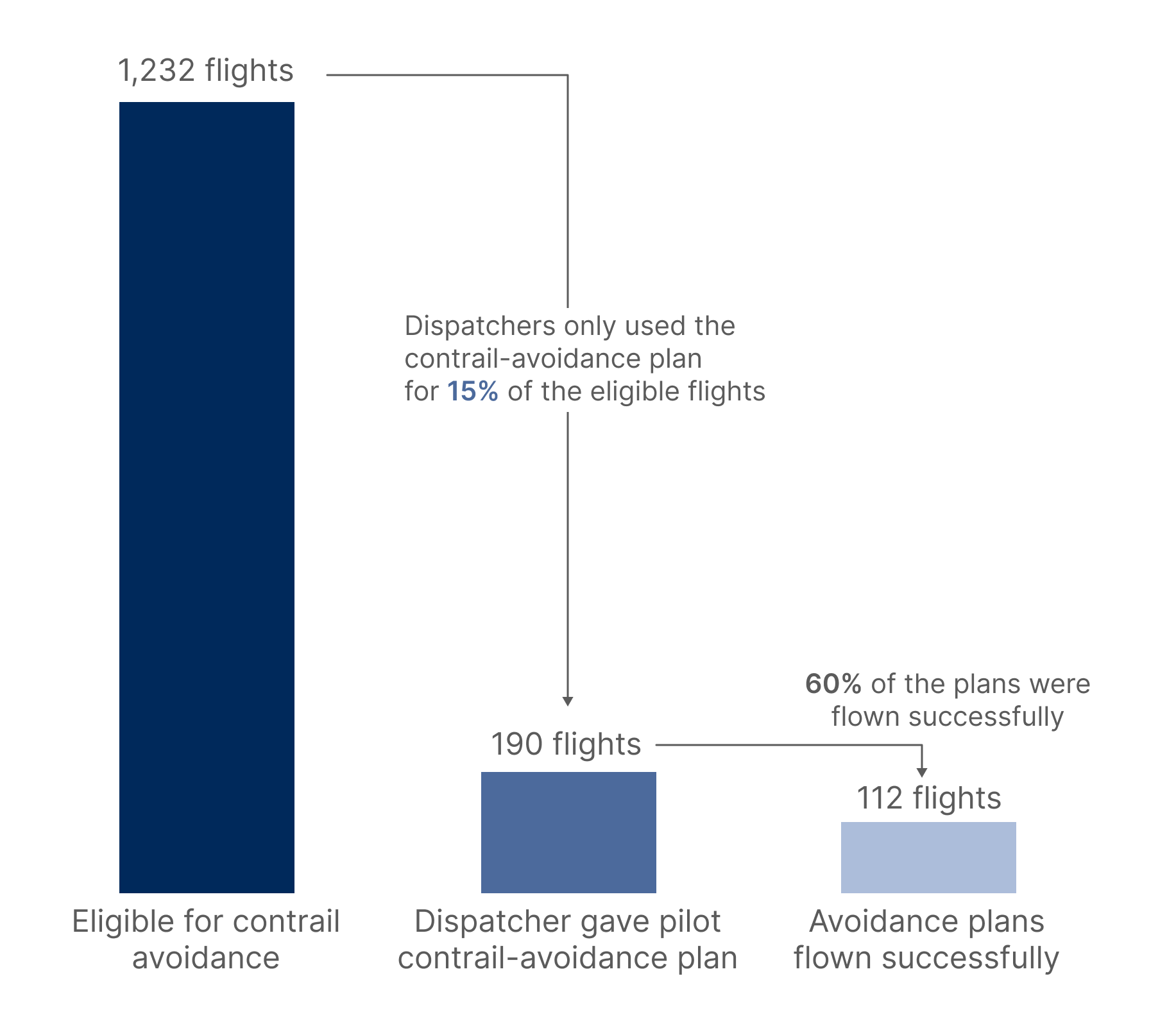
But for the planes that did follow the avoidance plan, contrails were reduced by almost two-thirds.3 The technology works when it’s executed.
The problem was that fewer than one-in-ten eligible flights actually took that route. Why?
There are two steps to consider: whether the dispatcher chose the route, and then whether the pilot managed to execute it. The biggest bottleneck was the dispatcher’s decision; most flight crews didn’t even receive a contrail-avoidance plan.
There are several reasons the dispatcher might not choose it. The first one is simply busyness: I can imagine aircraft dispatch being a stressful job at times, with lots of spinning plates. If you’re stressed, and someone asks whether the next flight should follow the standard route or a less familiar one, you’re probably going to choose the former. That’s especially true given that participation was totally voluntary.
To avoid contrails, planes would often have to climb and descend mid-flight. This is safe to do, but not standard, so you can see why dispatchers might opt for the simpler, more typical route.
Their choices were also limited by the maps and information they received. They only got a top-down map view, rather than a vertical profile. This meant they couldn’t really understand why up-and-down changes were needed to optimise the route. Without complete information, they were less trusting and confident in the decision.
There are also reasons why contrail-avoidance plans were only flown successfully 60% of the time. First, the pilots didn’t receive complete information in the cockpit; without properly understanding the rationale for the request and why they were being asked to follow a specific, non-standard route, they were more likely to deviate slightly. Even relatively small deviations could mean they failed to avoid the conditions that create contrails.
In some cases, the dispatcher had made manual adjustments to a plan, which directed pilots back into the contrail-formation zone. Again, because they didn’t have a vertical profile of the routes, they didn’t know that these adjustments put the planes back into the avoidance zone.
These are not insurmountable barriers.
The fact that this program was entirely voluntary clearly makes a difference. If optimisation for contrail avoidance were mandatory or even incentivised, you wouldn’t have such low uptake rates. It was also very new to dispatchers, making them understandably resistant; the more common this became, the more comfortable they’d be in choosing alternative routes.
The authors of the study think that a better user interface, especially with a vertical profile of the routes, would have made a big difference. And further down the line, a more automated workflow where the contrail-optimised route became the default (or standard) one would also change the uptake rate dramatically.4
This study was an insightful test of the difference between technical feasibility and operational reality. Yes, the technology can improve, but it will be the operational barriers — and the regulatory or financial support needed to overcome them — that will determine whether the aviation industry can beat its contrails problem.
The 2% figure comes from:
Lee, D. S., Fahey, D. W., Skowron, A., Allen, M. R., Burkhardt, U., Chen, Q., ... & Wilcox, L. J. (2021). The contribution of global aviation to anthropogenic climate forcing for 2000 to 2018. Atmospheric Environment.
I covered cost estimates in my previous article on contrails.
This was based on a filtering mechanism: flights that would generate less than 10 tonnes of carbon dioxide equivalents of warming through contrail formation were excluded. Only those that met the threshold were included in either group.
The specific figure was a 63% reduction in contrails.
One final thing to note — which I found surprising — is that the study reported no statistically significant increase in fuel use in the diverted flights. Previous studies suggest that planes don’t burn much additional fuel (which is why it’s so cheap, and why it actually reduces climate impacts), but no increase in fuel burn was unexpected.
Perhaps there was some selection bias: dispatchers may have accepted the contrail-optimised plan when it was simpler and required a smaller diversion from the standard route. Those are the flights where you’d expect less additional fuel.
I’m still a bit cautious of those results and would want to see more studies with larger sample sizes. But I do think that it gives some confidence that the extra fuel burn is very small, even if it’s not zero.
The reduction in contrails looks to be real, but the climate impacts are less clear. Contrails’ radiative forcing is still an open question, and even the author of the 2021 paper thinks they might have been too high. See quote in here: https://www.science.org/content/article/airplane-contrails-may-not-be-climate-villain-once-feared
One potential reason for the overestimate is that in-cloud contrails may play an important role. Petzold et al suggest they are the large majority of contrails, and their effect is uncertain. They may have a cooling effect by making clouds thicker. https://www.nature.com/articles/s41467-025-65532-2
Having said that, the reduction in contrails suggests the forecasting system can accurately predict when and where clear sky contrails (at least as picked up by GOES) will form. Given all the unknowns about contrails this is an exciting tool that we could learn a lot from
Thanks for this important analysis. When I see a headline figure of 2% saving in GHG, I think about surface transport emissions from fossil fuelled vehicles and how easy it ought to be to save at least that amount by reducing speed limits and encouraging eco-driving. Less acceleration and braking by ‘reading the road’ instead of rushing to the next bend or junction.
Can you analyse the effect of reducing motorway speed limits to 60mph? It may happen anyway in response to Trump’s Middle East adventure.